Nine acres of second chances.
9003 Governors Row, Dallas, TX 75247 - eleven dock doors, four wash bays, a granulation room, a fabrication shop and enough paved staging to hold nine thousand containers.
Schedule a dock appointment
Dropping off, picking up, or bringing a trailer of empties? Book it here and we will confirm a time.
What is in each bay.
Material moves in one direction: intake on the east side, outbound on the west, nothing crosses.
| Zone | Function | Capacity | Notes |
|---|---|---|---|
| Intake & triage | Serial capture, UN plate read, contents log | 400 units/day | Nothing moves until it is logged |
| Wash bays 1-3 | Hot caustic, triple rinse, general service | 900 units/day | Counter-current water recovery |
| Wash bay 4 | Food-grade protocol, isolated circuit | 300 units/day | Swab verified, separate drains |
| Rebuild line | Cage straightening, valve and gasket change | 700 units/day | Hydraulic press, torque-logged |
| Test cell | Leak and pressure testing, UN recertification | 500 units/day | 31HA1 renewal documentation |
| Granulation | Shred, wash, dry, bag HDPE regrind | 14,000 lb/day | Fed only by failed bottles |
| Fabrication shop | Cutting, welding, plumbing, branding | Custom | Upcycled goods and bespoke builds |
| Outbound staging | Load build, wrap, bill of lading | 9,000 units | Eleven doors, two flatbed ramps |
We book 2,600 loads a year out of this yard.
Dallas sits inside a one-day drive of 40% of the US population by truck. We run our own flatbeds inside a 300-mile radius and broker vans, flatbeds and partials everywhere else through carriers we have used for a decade.
A full truckload of empty caged IBCs is 40 to 48 units depending on stacking and trailer height. Below that we consolidate with other outbound freight, which is why a partial load from us usually beats an LTL quote.
If you are coming to the yard.
Governors Row is an industrial street in the Stemmons corridor. Enter from the north gate; GPS sometimes points at the back fence.
9003 Governors Row
Dallas, TX 75247
Monday - Thursday
7:00 AM - 5:00 PM CT
Friday
7:00 AM - 3:00 PM CT
Saturday
8:00 AM - 12:00 PM CT (dock pickups only)
Sunday
Closed
Check in at the scale house, not the office. PPE is required past the yellow line: steel toe, hi-vis and safety glasses. We keep loaners.
What is actually bolted to the floor.
Published because capability claims are cheap and equipment lists are not.
| Equipment | Count | Purpose | Notes |
|---|---|---|---|
| Three-stage wash tunnels | 3 | General reconditioning | Counter-current rinse, reclaimed caustic |
| Isolated food-grade wash cell | 1 | Food contact programme | Own tanks, pumps and drains |
| Three-chamber clarifier | 1 | Solids separation | Permitted discharge to municipal sewer |
| Hydraulic cage press | 2 | Cage straightening | Welds inspected after every press |
| Leak and pressure test rigs | 4 | 100% testing | Records written against the serial |
| Knife mill granulator | 1 | Failed bottles to flake | 14,000 lb/day |
| Flake wash and float tank | 1 | Contamination separation | Feeds the dryer |
| Plasma cutting table | 1 | Fabrication | DXF from customer drawings |
| MIG welding bays | 2 | Frames, skids, lifting eyes | Custom builds and bunded skids |
| Forklifts, 5,000-8,000 lb | 11 | Yard and dock | Two with moffett capability on trailers |
| Box trucks and flatbeds | 6 | Own-fleet local work | 300-mile radius |
| XRF alloy analyser | 1 | Stainless verification | Every stainless vessel at intake |
How material moves through the building.
One direction, east to west, with no crossing between dirty and clean. The layout is the quality system.
East docks
Intake only. Scale house, triage, four-point logging. Nothing enters the building unlogged.
Centre bays
Wash, with food grade physically isolated in its own cell on a separate circuit.
North line
Rebuild and test. Cage press, hardware, leak and pressure testing, regrade and tag.
West docks
Outbound staging, wrap, bill of lading. Clean material never returns east.
What the building can actually do in a day.
The real constraints, bay by bay. When we quote a lead time, it is this table doing the arithmetic.
| Operation | Daily capacity | Constrained by | Overflow option |
|---|---|---|---|
| Intake and grading | 1,600 units | Scale house and yard space | Staged outside, counted next morning |
| Standard wash, bays 1 to 3 | 1,200 units | Water treatment throughput | Second shift |
| Food grade wash, bay 4 | 90 units | Isolated circuit and swab turnaround | None - this is the hard limit |
| Rebottling | 60 units | Cage press and shop labour | Overtime, limited |
| Testing and recertification | 140 units | Test cell stations | Scheduled in blocks |
| Granulation | 22,000 lb | Granulator feed rate | Runs overnight unattended |
| Fabrication | Varies | Shop labour and queue | Subcontract finishing |
| Loading | 11 trailers | Dock doors and forklift coverage | Flatbed loading in the yard |
What is under and around the building.
The part of a container yard that nobody photographs and that determines whether it can legally operate.
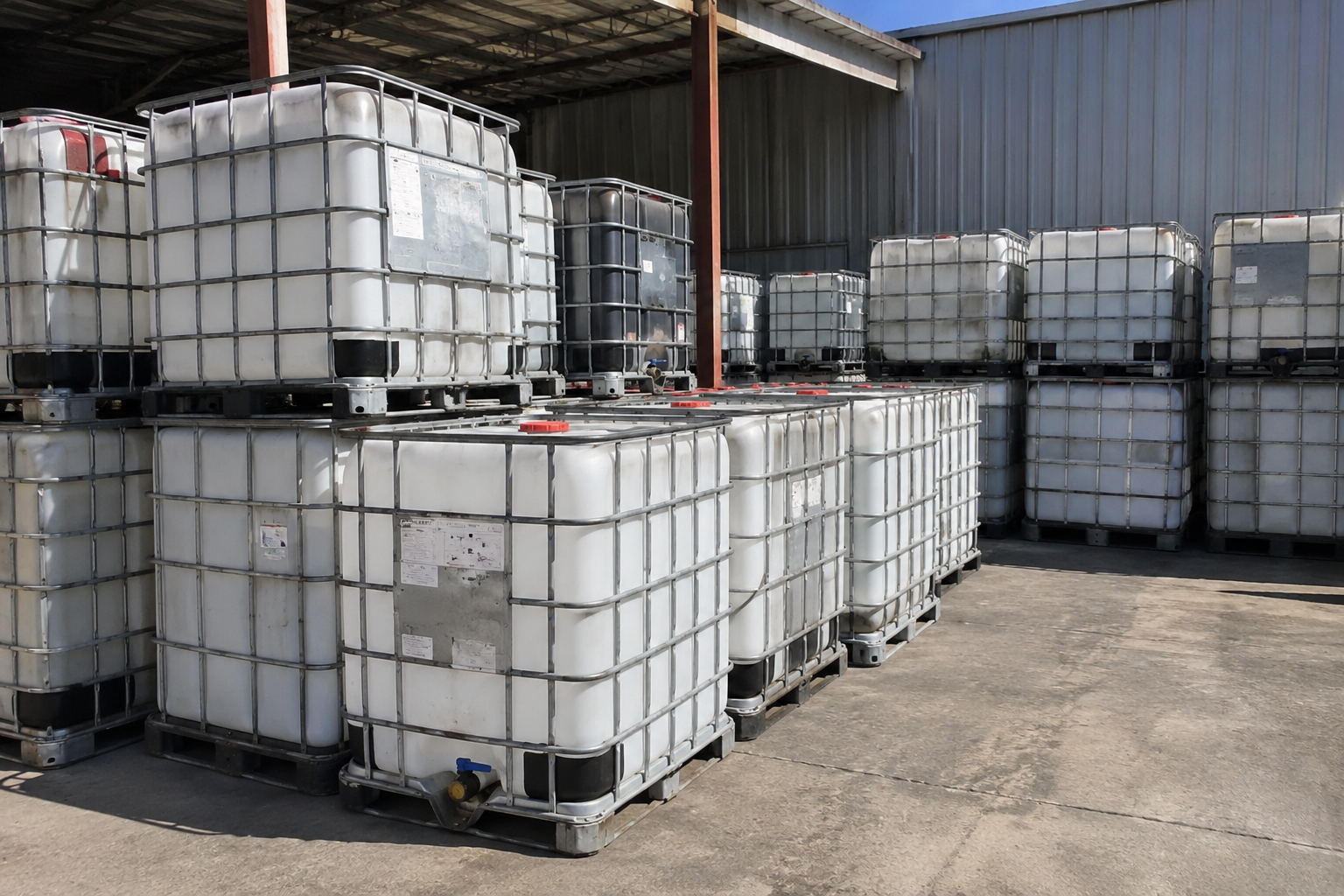
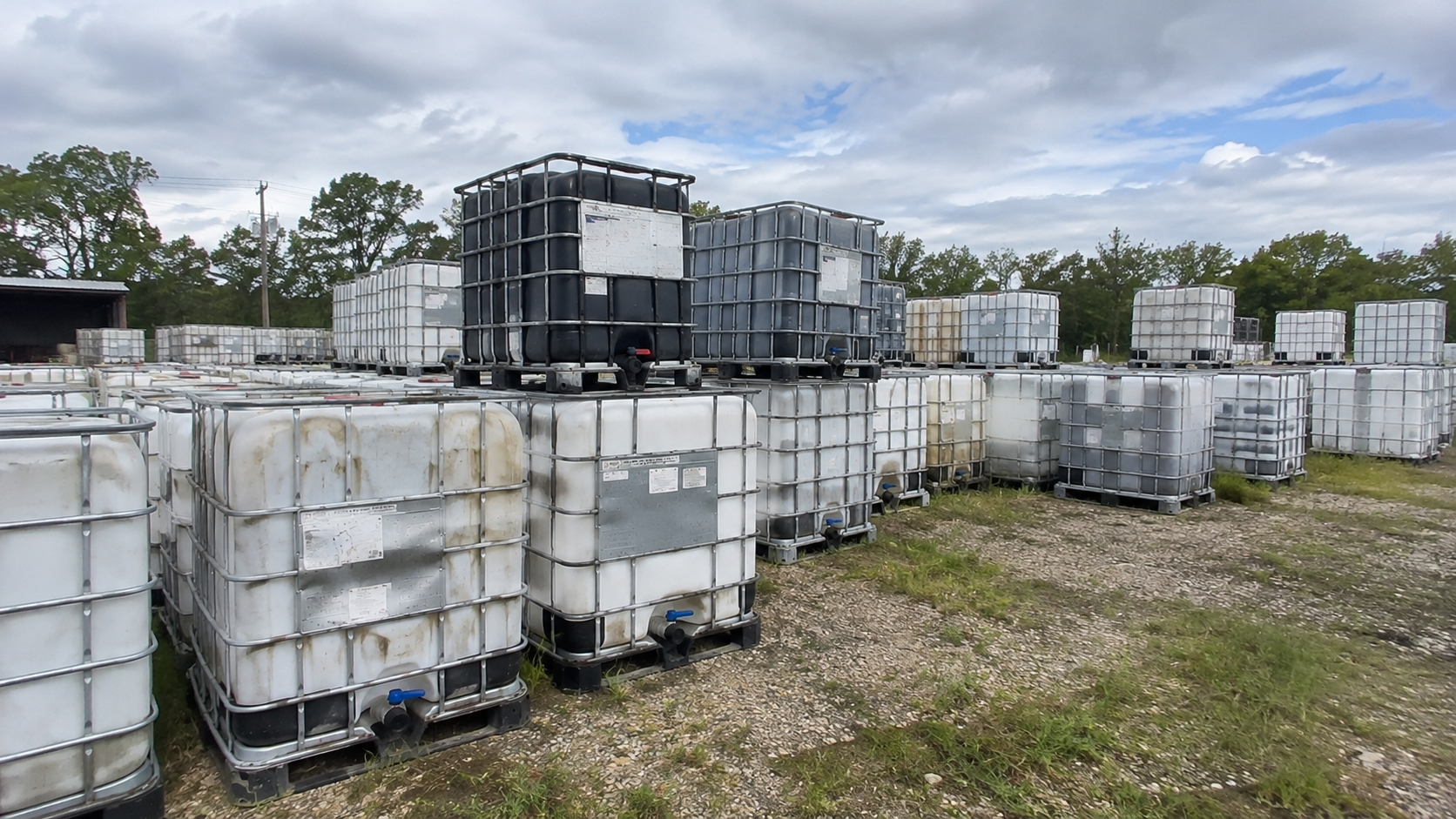
The concrete matters more than the building. Every surface a container touches drains to an interceptor rather than to the storm system, which is what allows us to handle containers with residue in the open air at all. A yard on gravel cannot do this work legally, whatever it says on its website.
The second thing worth knowing is the separate water meter. Our wash water consumption is measured independently of everything else on site, which is why the per-unit water figure we publish is a measured number rather than an estimate.
Nine acres, photographed on an ordinary week.
Everything a container touches here drains to an interceptor rather than to the storm system. That concrete is the reason this work can be done outdoors at all.

Bring us a trailer of empties.
Scheduled drop-offs get priority at the scale house and a same-day count. Tell us what is coming and when.
The numbers people ask us for twice a week.
Specifications, capability and contact details in one block, so you never have to go hunting for them from wherever you happen to be on this site.
- Buy used IBC totes, drums, cages and pallets nationwide
- Sell reconditioned, rebottled and food grade containers
- Hot caustic wash with counter-current triple rinse
- Food grade protocol in an isolated circuit with swab verification
- UN 31HA1 leak and pressure testing with reconditioner marking
- Cage straightening, revalving and full hardware replacement
- Freight booking: partial, consolidated and full truckload
- Managed container fleet programmes from 150 units
- On-site granulation into clean HDPE regrind
- Custom fabrication, plumbing, branding and upcycled builds
Write to us
Every message is read by a person in Dallas and answered within one business day.
Container fast reference.
Nominal figures for the containers we stock. Gross weights assume water at 8.345 lb per gallon - multiply by your product specific gravity.
| Container | Capacity | Footprint | Height | Tare | Gross (water) | Outlet |
|---|---|---|---|---|---|---|
| Caged IBC, standard | 275 gal / 1,041 L | 48" x 40" | 46" | 125 lb | 2,419 lb | S60x6 |
| Caged IBC, tall | 330 gal / 1,249 L | 48" x 40" | 53" | 148 lb | 2,902 lb | S60x6 |
| Caged IBC, low profile | 180 gal / 681 L | 48" x 40" | 35" | 104 lb | 1,606 lb | S60x6 |
| Caged IBC, compact | 120 gal / 454 L | 40" x 32" | 34" | 78 lb | 1,079 lb | S60x6 |
| Stainless IBC | 350 gal / 1,325 L | 48" x 42" | 51" | 320 lb | 3,241 lb | NPT / TC |
| Poly drum, tight head | 55 gal / 208 L | 23" dia. | 35" | 22 lb | 481 lb | 2" NPS |
| Steel drum, tight head | 55 gal / 208 L | 23" dia. | 34" | 38 lb | 497 lb | 2" NPS |
Five answers that apply wherever you are.
01What does a used IBC tote actually cost?
It depends on grade, quantity and your distance from Dallas, and freight is often the biggest single variable. Grade C units are a fraction of Grade A, rebottled sits near the top, and food grade is priced by scarcity of documented stock. Send a quantity and a zip code and you get a landed number, not a range. The pricing guide shows the bands we work in on the buy-back side.
02How fast can I get containers?
Stock units leave the yard in two to three business days, rebottled in two to five, food grade in three to seven. Add transit: next day in the Texas triangle, two to three days through the Midwest and Southeast, three to five to the coasts. Full lane detail is on the locations page.
03Will you buy the empties I already have?
Yes, in all 48 contiguous states, including damaged units and mixed unsorted lots. Freight is netted into the price so you see one clear per-unit number, and within 150 miles of Dallas collection is free. Details on we buy your totes.
04How do I know what grade I need?
Tell us the cargo rather than the grade. We publish a written grading standard and we will usually recommend a cheaper grade than people ask for, because most jobs do not need appearance. The Tote Matchmaker encodes the same conversation in four questions.
05Why is there no phone number anywhere on this site?
Because we have never had one. Written answers give you a record, a quote you can forward and a grade you can hold us to, and they are a large part of why every request gets answered within one business day. The form on this page reaches the same people a phone line would have.
Everything, from here.
Containers
Services
Reference
Looking for something that is not listed? The full site index has every page, including the inner pages that are not in the main menu.