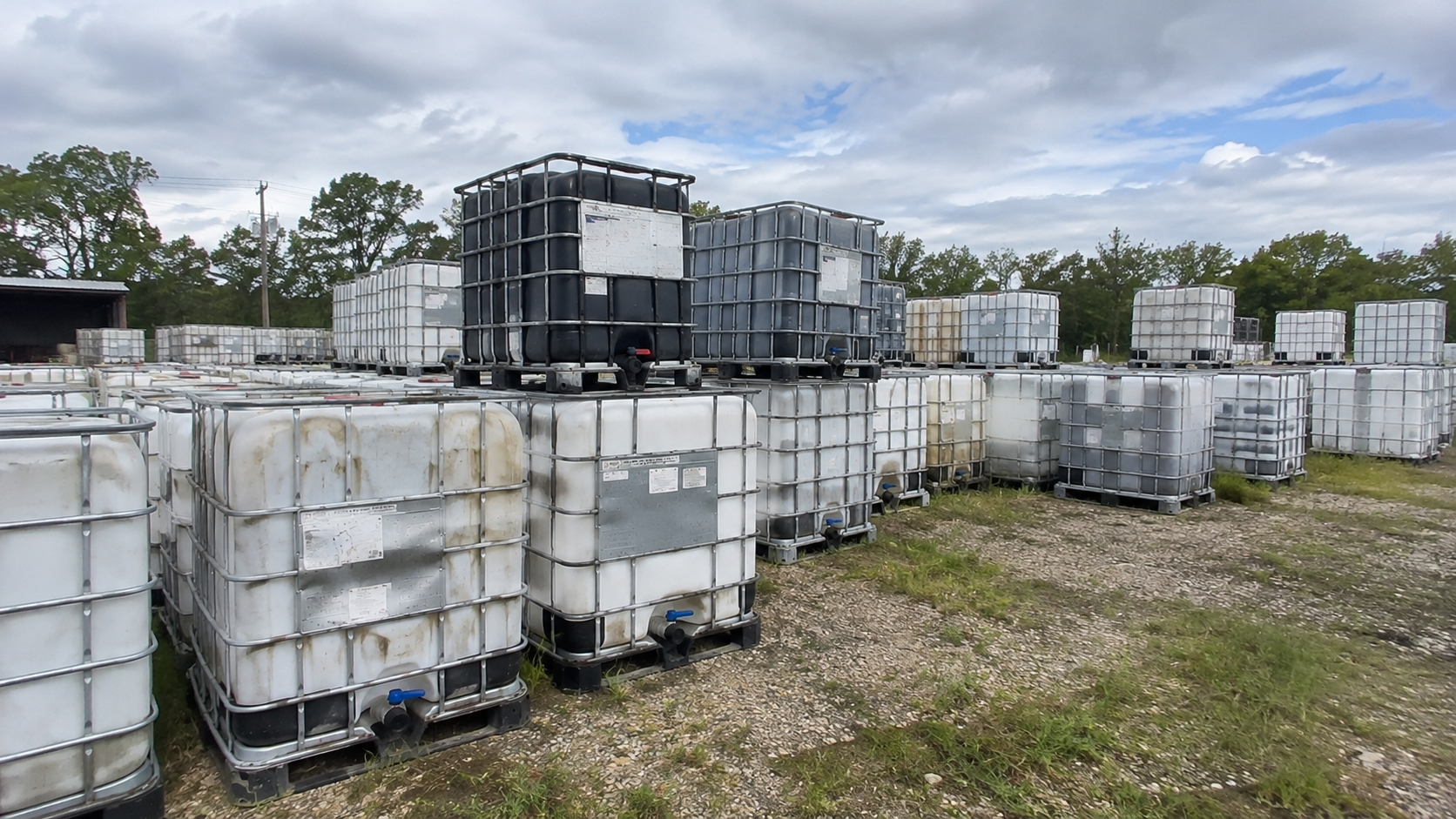
Retirement, but the tote keeps working.
Some containers are too tired for liquid freight and too sound to shred. Those go to the fabrication shop, where they become rain harvesting kits, grow beds, wash stations and planters - products with another decade in them.
Build something
Standard kits ship from stock. Custom builds start with a sketch in the Message field.
What the shop turns out.
All built on Grade C containers that would otherwise be granulated, with new food-safe plumbing where water is involved.
Rain harvesting kits
275 or 330 gallon catchment with first-flush diverter, mosquito screen, overflow and a garden hose outlet. Linkable into banks of four.
Best seller
02Aquaponics & grow beds
Cut, framed and plumbed tote systems for media beds, deep water culture and fish tanks, with the cage reused as the frame.
Build guide
03Wash & spray stations
Portable wash stations with pump, filter and hose reel mounted directly on the cage.
Custom
04Planters & site furniture
Half-cut planters, raised beds, barricades and fire-training props for municipalities.
Custom
From condemned to useful.
Selected
Only units that failed liquid-freight inspection but passed structural checks.
Stripped & cut
Hardware removed, bottle cut on a jig so the edges are straight and safe.
Rebuilt
Cage reused as the frame, new food-safe plumbing, screens and hardware fitted.
Finished
Edges capped, stenciled, tested with water and loaded onto its own pallet.
A tote that waters a garden for ten more years beats a tote that becomes a pellet today.
Which containers become upcycled goods.
Only units that failed liquid-freight inspection but passed structural checks, and only with histories we are willing to put behind a product.
| Donor condition | Becomes | History required | Why it failed liquid service |
|---|---|---|---|
| Sound cage, crazed bottle | Planter, barricade, cut build | Any benign | Crazing ends liquid service permanently |
| Sound bottle, odour retention | Rain kit, irrigation tank | Food or benign only | Odour would transfer to product |
| Sound unit, illegible UN plate | Wash station, grow bed | Food or benign only | Cannot return to regulated service |
| Sound unit, old bottle date | Rain kit, aquaponics | Food only for water builds | Too old for commercial liquid freight |
| Cage only | Frames, grow bed supports, fencing | n/a | Bottle condemned separately |
Cutting a container yourself.
People do this constantly and the injuries are entirely predictable. If you are going to do it, do these six things.
Know the history first
Never cut a container whose previous cargo is unknown. Residue plus a grinder is an ignition risk, not a theory.
Wash and ventilate
Clean it, then leave it open. Vapour in the headspace is the hazard, not the liquid you already drained.
Cage first, with a thin wheel
Angle grinder with a cutoff wheel, eye and face protection, sleeves down. Sparks and galvanising fumes both.
Bottle with a jig
Jigsaw or hot knife along a marked line. Freehand cuts wander and leave edges nobody wants to touch.
Cap every edge
Cut HDPE is genuinely sharp. Edge trim or split tubing, on every cut, every time.
Never enter it
Not to clean, not to retrieve something. A tote is a confined space with a restricted opening and people have died in them.
Everything the shop makes, with real numbers.
These are standing builds, priced and repeatable. Anything here can be modified, and roughly a third of what the shop ships is a variation on one of these.
| Build | Base container | Finished footprint | Capacity | Build time | Suits |
|---|---|---|---|---|---|
| Rain harvesting kit, single | 275 gal Grade C | 48" x 40" | 275 gal | 1 day | Domestic, garden |
| Rain harvesting bank, double | Two 275 gal | 96" x 40" | 550 gal | 2 days | Smallholding, nursery |
| Media bed aquaponics | 275 gal cut long | 48" x 40" | 180 gal plus bed | 2 days | Education, hobby |
| Deep water culture raft | 275 gal cut flat | 48" x 40" | 150 gal | 2 days | Leafy greens |
| Wash station, single bay | 275 gal plus frame | 60" x 44" | 275 gal | 3 days | Site, workshop |
| Spray cart, towable | 275 gal on frame | 72" x 48" | 275 gal | 4 days | Agriculture, grounds |
| Raised planter, long | 275 gal cut in half | 48" x 40" | Two beds | Half day | Landscaping |
| Site furniture bench | Cage and pallet | 48" x 20" | - | Half day | Yards, public space |
| Tool and parts locker | Cage with doors | 48" x 40" | - | 1 day | Depots, workshops |
| Dog bath / stock trough | 275 gal cut low | 48" x 40" | 90 gal | 1 day | Kennels, farms |
What we can do to a container that is no longer a container.
Once a unit is condemned for liquid service it becomes raw material, and raw material can be cut, welded, coated and plumbed.
Powder coating is the finish most people underestimate. A bare galvanized cage looks industrial, which is fine on a yard and wrong in a school courtyard or a hotel garden. A coated cage costs little, lasts years outdoors and makes the difference between a build that reads as salvage and one that reads as furniture.
On the plastic side, the constraint is that HDPE only bonds properly to itself and only by welding. Adhesives do not hold on polyethylene in any way you should trust with water. If a build needs a watertight joint in plastic, it is extrusion welded, and if that is not practical we design the joint out.
Got a drawing? We have a plasma cutter.
Municipalities, schools, farms and breweries all order custom builds from us. Describe it and we will price it.
The numbers people ask us for twice a week.
Specifications, capability and contact details in one block, so you never have to go hunting for them from wherever you happen to be on this site.
- Buy used IBC totes, drums, cages and pallets nationwide
- Sell reconditioned, rebottled and food grade containers
- Hot caustic wash with counter-current triple rinse
- Food grade protocol in an isolated circuit with swab verification
- UN 31HA1 leak and pressure testing with reconditioner marking
- Cage straightening, revalving and full hardware replacement
- Freight booking: partial, consolidated and full truckload
- Managed container fleet programmes from 150 units
- On-site granulation into clean HDPE regrind
- Custom fabrication, plumbing, branding and upcycled builds
Write to us
Every message is read by a person in Dallas and answered within one business day.
Container fast reference.
Nominal figures for the containers we stock. Gross weights assume water at 8.345 lb per gallon - multiply by your product specific gravity.
| Container | Capacity | Footprint | Height | Tare | Gross (water) | Outlet |
|---|---|---|---|---|---|---|
| Caged IBC, standard | 275 gal / 1,041 L | 48" x 40" | 46" | 125 lb | 2,419 lb | S60x6 |
| Caged IBC, tall | 330 gal / 1,249 L | 48" x 40" | 53" | 148 lb | 2,902 lb | S60x6 |
| Caged IBC, low profile | 180 gal / 681 L | 48" x 40" | 35" | 104 lb | 1,606 lb | S60x6 |
| Caged IBC, compact | 120 gal / 454 L | 40" x 32" | 34" | 78 lb | 1,079 lb | S60x6 |
| Stainless IBC | 350 gal / 1,325 L | 48" x 42" | 51" | 320 lb | 3,241 lb | NPT / TC |
| Poly drum, tight head | 55 gal / 208 L | 23" dia. | 35" | 22 lb | 481 lb | 2" NPS |
| Steel drum, tight head | 55 gal / 208 L | 23" dia. | 34" | 38 lb | 497 lb | 2" NPS |
Five answers that apply wherever you are.
01What does a used IBC tote actually cost?
It depends on grade, quantity and your distance from Dallas, and freight is often the biggest single variable. Grade C units are a fraction of Grade A, rebottled sits near the top, and food grade is priced by scarcity of documented stock. Send a quantity and a zip code and you get a landed number, not a range. The pricing guide shows the bands we work in on the buy-back side.
02How fast can I get containers?
Stock units leave the yard in two to three business days, rebottled in two to five, food grade in three to seven. Add transit: next day in the Texas triangle, two to three days through the Midwest and Southeast, three to five to the coasts. Full lane detail is on the locations page.
03Will you buy the empties I already have?
Yes, in all 48 contiguous states, including damaged units and mixed unsorted lots. Freight is netted into the price so you see one clear per-unit number, and within 150 miles of Dallas collection is free. Details on we buy your totes.
04How do I know what grade I need?
Tell us the cargo rather than the grade. We publish a written grading standard and we will usually recommend a cheaper grade than people ask for, because most jobs do not need appearance. The Tote Matchmaker encodes the same conversation in four questions.
05Why is there no phone number anywhere on this site?
Because we have never had one. Written answers give you a record, a quote you can forward and a grade you can hold us to, and they are a large part of why every request gets answered within one business day. The form on this page reaches the same people a phone line would have.
Everything, from here.
Containers
Services
Reference
Looking for something that is not listed? The full site index has every page, including the inner pages that are not in the main menu.