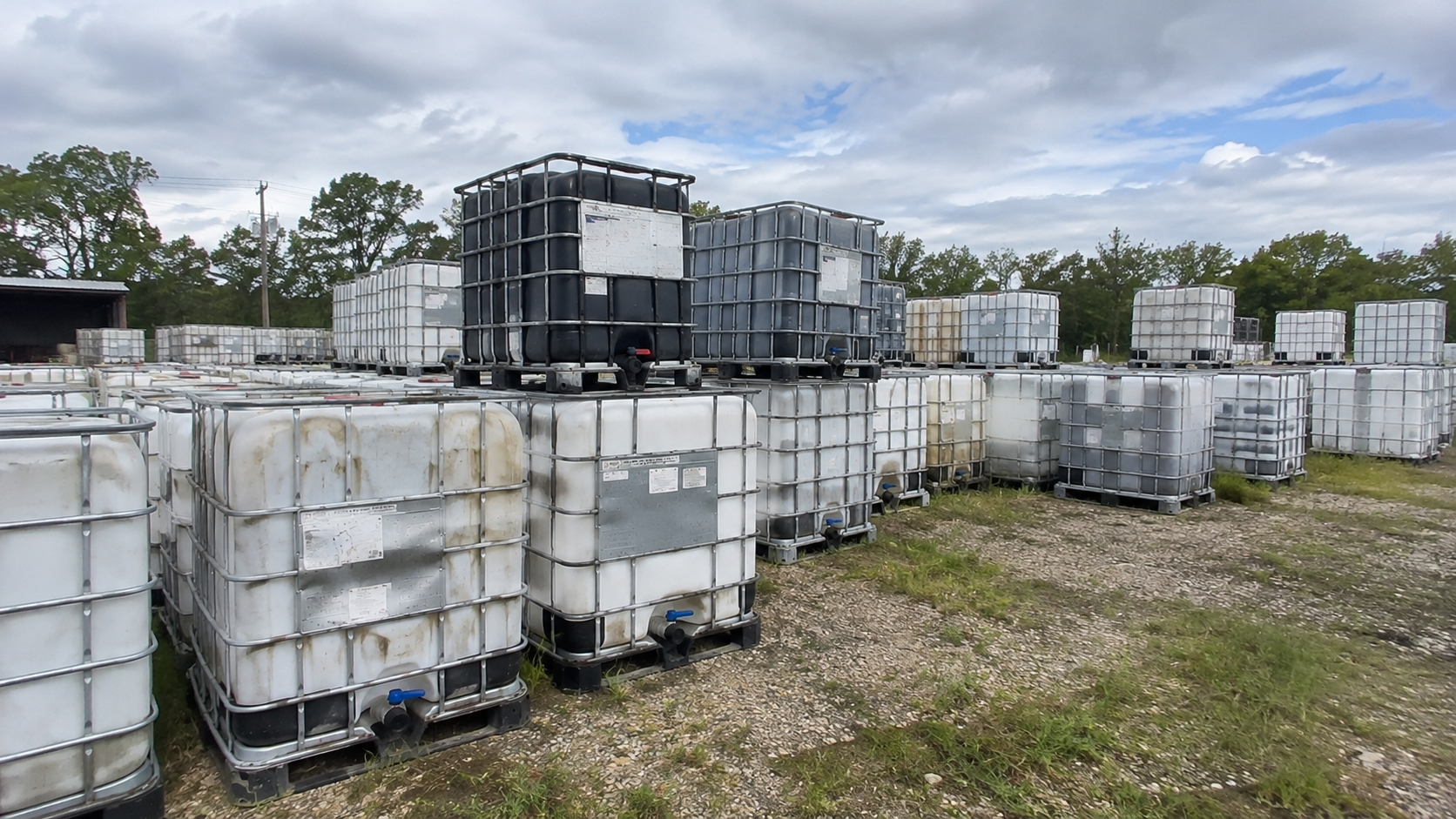
Move the slider. Watch a landfill not happen.
Every reuse cycle is one container that was never manufactured. Set your fleet size and cycle rate and the engine applies our published per-unit factors - the same ones in our annual file.
Get the methodology PDF
We will send factors, sources, assumptions and a per-serial ledger for the containers you actually bought.
Each reuse replaces one container that would otherwise have been manufactured. Factors are cradle-to-gate, 2025 model year, transport held constant.
What the whole operation has avoided.
Cumulative, audited internally, published annually.
Where the factors come from.
Published so you can argue with them. Several customers have, and two of the factors changed as a result.
| Factor | Value per 275 gal unit | Basis | Excluded |
|---|---|---|---|
| CO2e avoided | 118 kg | New unit 138 kg minus reconditioning 20 kg | Outbound freight |
| Water avoided | 46 gal | New unit 52 gal minus net wash draw 6 gal | Municipal supply losses |
| Mass diverted | 134 lb | Full container mass at end of life | Pallet if customer retains |
| Virgin resin avoided | 61 lb | Bottle mass, virgin HDPE | Hardware |
| Steel avoided | 73 lb | Cage plus steel pallet mass | Composite pallet variant |
| Energy avoided | 354 MJ | Cradle-to-gate manufacturing energy | Customer-side energy |
Questions auditors ask.
01Can we put this in a sustainability report?
Yes, with the method attached, and we will supply a per-serial ledger of the containers you actually purchased. Describe it as avoided impact, not as neutrality - see what we refuse to claim.
02Is this Scope 3 relevant?
It affects purchased goods and services. Your reporting framework decides how avoided impact is presented; we provide the underlying data either way.
03Why is freight excluded?
Because it depends on where you are, not on what we did. We supply lane-specific freight emissions separately on request.
04Are offsets included?
No. Nothing on this site is netted with purchased credits. Every figure is a physical avoidance or a measured flow.
05How often are factors updated?
Annually, with the model year noted. When a factor changes we republish the prior value alongside it rather than quietly restating history.
What the numbers mean in ordinary terms.
Avoided impact is abstract until it is converted into something physical. These are the conversion factors the engine uses.
| Quantity | Equivalent to | Basis |
|---|---|---|
| 1 container reused | 118 kg CO2e avoided | New unit 138 kg minus reconditioning 20 kg |
| 39 containers reused | 1 passenger car off the road for a year | 4.6 tonnes CO2e per car annually |
| 64 containers reused | 1 US home powered for a year | 7.5 tonnes CO2e per home annually |
| 1 container reused | 2.7 ten-minute showers of water | 46 gallons at 17 gallons per shower |
| 100 containers reused | 11.8 tonnes CO2e, 4,600 gal water | Direct multiplication |
| 1,000 containers reused | 118 tonnes CO2e, 46,000 gal water | Direct multiplication |
| Our 2009-2026 total | 229 million kg CO2e | 1.94 million containers, cumulative |
Where the biggest reductions actually are.
In descending order of effect, from our own customer data.
Stop buying new entirely
A managed programme where we own and maintain the fleet means no container is manufactured for your product at all. By a wide margin the largest single reduction available.
Extend container life
Store shaded, rinse at emptying, replace gaskets. Going from four cycles to seven cuts your packaging footprint per fill by nearly half.
Cut your loss rate
Every container that does not come back is one that has to be replaced. Halving a 5 percent loss rate on 400 units saves 10 containers a year.
Rebottle instead of replacing
A sound cage with a tired bottle is 73 lb of steel you do not need to buy again.
Fill the trailer
A half-empty truck can double the freight emissions per container delivered. Consolidation is the one lever where cheap and low-carbon are identical.
Buy the right grade
Over-specifying grade pulls scarce high-grade stock out of the market without changing the environmental outcome at all.
Every number the engine multiplies, with its source.
Published so you can rebuild our arithmetic rather than take it on trust. If your own model uses different factors, these are the ones to swap out.
| Factor | Value | Applies to | Basis |
|---|---|---|---|
| CO2e avoided per reconditioned IBC | 118 kg | 275 and 330 gal caged IBC | Cradle-to-gate of a new unit, less our wash and inbound freight |
| Landfill mass avoided per IBC | 134 lb | Bottle, cage, pallet, hardware | Weighed, not estimated |
| Fresh water used per wash | 46 gal | Standard wash protocol | Separately metered at the site |
| Virgin HDPE per new bottle | 61 lb | 275 gal bottle | Weighed from new stock |
| Steel per new cage and pallet | 73 lb | 275 gal cage and steel pallet | Weighed from new stock |
| CO2e of manufacturing a new IBC | about 138 kg | 275 gal composite | Resin, moulding, steel, assembly |
| CO2e of our reconditioning cycle | about 20 kg | Per unit | Site energy, water, treatment, yard movements |
| Regrind displacing virgin resin | 1:1 by mass | HDPE regrind sold | Conservative - no quality discount applied |
| Drums, relative factor | about 18 percent of an IBC | 55 gal drum | Scaled by mass and material |
Six reasons not to over-claim with these numbers.
We would rather you used a smaller number you can defend than a larger one that collapses in an audit.
01Avoidance is not the same as neutrality
Every figure here is an avoided emission against a stated baseline - what would have happened if you had bought a new container instead. It does not offset anything, it cannot be subtracted from your gross emissions, and it should never be described as carbon neutral. It belongs in a narrative section or a Scope 3 reduction, not in a neutrality claim.
02The baseline assumes you would have bought new
If your realistic alternative was buying a used container from somebody else rather than a new one, the avoided impact is much smaller. Be honest about your counterfactual - it is the first thing a competent auditor will ask about.
03Our boundary stops at our gate
We count our own washing, treatment and inbound freight as a deduction. We do not count the freight to you, your use phase or what happens to the container after you finish with it. Those are yours to account for.
04Reuse counts once, not every fill
The avoided manufacture of one container is a single event. Filling it forty times does not avoid forty containers. A surprising number of published supplier claims quietly make this mistake.
05Equivalences are illustrative only
Comparisons to cars, flights or swimming pools are useful for a slide and useless in a report. Use the underlying figure and cite the methodology.
06Regrind displacement is an assumption
We count regrind as displacing virgin resin one-for-one by mass, which is a simplification. Recycled HDPE does not always substitute perfectly for virgin material in every application. If your methodology applies a quality factor, apply it here too.
Numbers are better with a signature under them.
We will send the methodology, the discharge permit and a ledger for your own purchases. Auditors like us.
The numbers people ask us for twice a week.
Specifications, capability and contact details in one block, so you never have to go hunting for them from wherever you happen to be on this site.
- Buy used IBC totes, drums, cages and pallets nationwide
- Sell reconditioned, rebottled and food grade containers
- Hot caustic wash with counter-current triple rinse
- Food grade protocol in an isolated circuit with swab verification
- UN 31HA1 leak and pressure testing with reconditioner marking
- Cage straightening, revalving and full hardware replacement
- Freight booking: partial, consolidated and full truckload
- Managed container fleet programmes from 150 units
- On-site granulation into clean HDPE regrind
- Custom fabrication, plumbing, branding and upcycled builds
Write to us
Every message is read by a person in Dallas and answered within one business day.
Container fast reference.
Nominal figures for the containers we stock. Gross weights assume water at 8.345 lb per gallon - multiply by your product specific gravity.
| Container | Capacity | Footprint | Height | Tare | Gross (water) | Outlet |
|---|---|---|---|---|---|---|
| Caged IBC, standard | 275 gal / 1,041 L | 48" x 40" | 46" | 125 lb | 2,419 lb | S60x6 |
| Caged IBC, tall | 330 gal / 1,249 L | 48" x 40" | 53" | 148 lb | 2,902 lb | S60x6 |
| Caged IBC, low profile | 180 gal / 681 L | 48" x 40" | 35" | 104 lb | 1,606 lb | S60x6 |
| Caged IBC, compact | 120 gal / 454 L | 40" x 32" | 34" | 78 lb | 1,079 lb | S60x6 |
| Stainless IBC | 350 gal / 1,325 L | 48" x 42" | 51" | 320 lb | 3,241 lb | NPT / TC |
| Poly drum, tight head | 55 gal / 208 L | 23" dia. | 35" | 22 lb | 481 lb | 2" NPS |
| Steel drum, tight head | 55 gal / 208 L | 23" dia. | 34" | 38 lb | 497 lb | 2" NPS |
Five answers that apply wherever you are.
01What does a used IBC tote actually cost?
It depends on grade, quantity and your distance from Dallas, and freight is often the biggest single variable. Grade C units are a fraction of Grade A, rebottled sits near the top, and food grade is priced by scarcity of documented stock. Send a quantity and a zip code and you get a landed number, not a range. The pricing guide shows the bands we work in on the buy-back side.
02How fast can I get containers?
Stock units leave the yard in two to three business days, rebottled in two to five, food grade in three to seven. Add transit: next day in the Texas triangle, two to three days through the Midwest and Southeast, three to five to the coasts. Full lane detail is on the locations page.
03Will you buy the empties I already have?
Yes, in all 48 contiguous states, including damaged units and mixed unsorted lots. Freight is netted into the price so you see one clear per-unit number, and within 150 miles of Dallas collection is free. Details on we buy your totes.
04How do I know what grade I need?
Tell us the cargo rather than the grade. We publish a written grading standard and we will usually recommend a cheaper grade than people ask for, because most jobs do not need appearance. The Tote Matchmaker encodes the same conversation in four questions.
05Why is there no phone number anywhere on this site?
Because we have never had one. Written answers give you a record, a quote you can forward and a grade you can hold us to, and they are a large part of why every request gets answered within one business day. The form on this page reaches the same people a phone line would have.
Everything, from here.
Containers
Services
Reference
Looking for something that is not listed? The full site index has every page, including the inner pages that are not in the main menu.