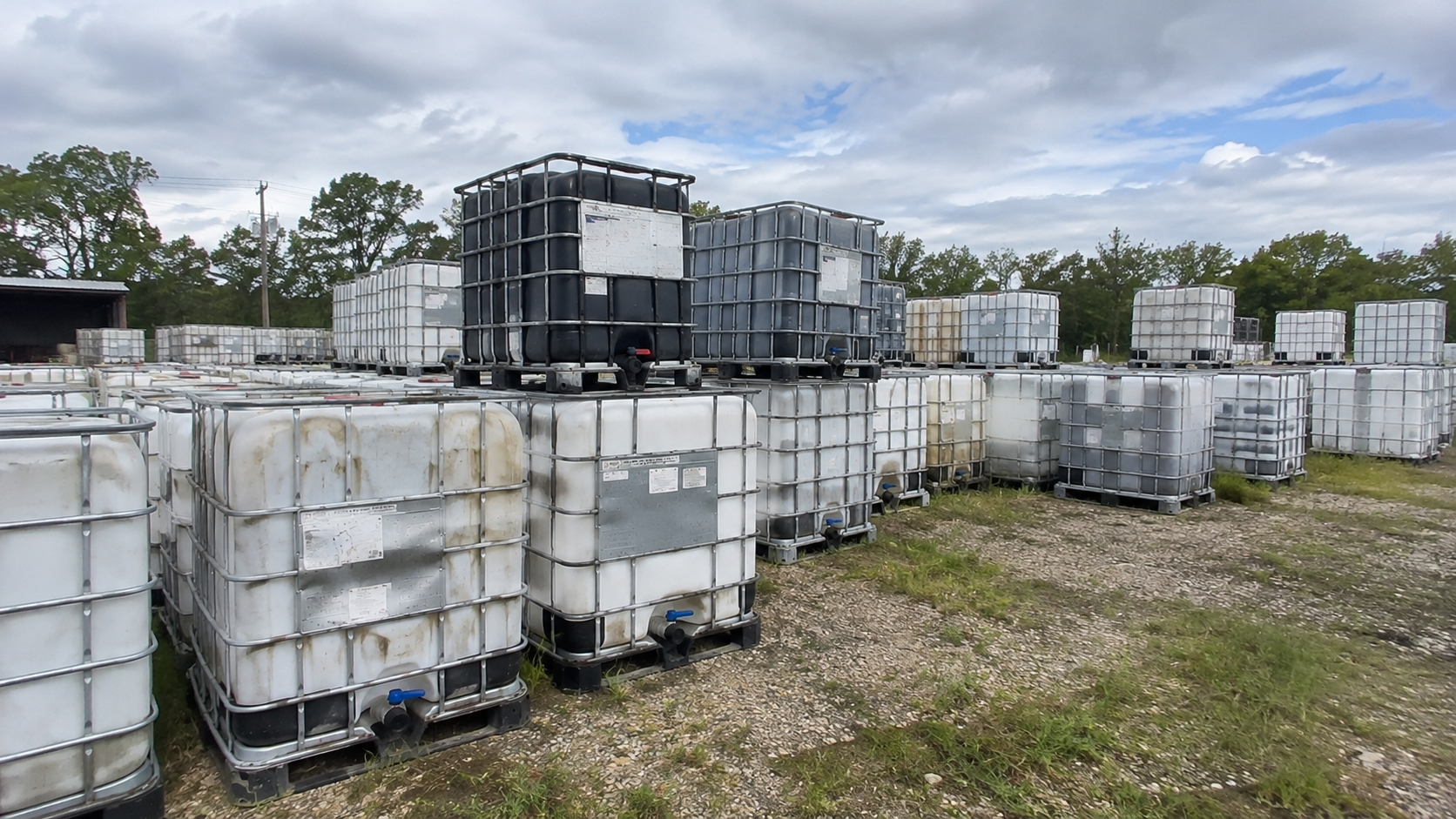
Recycling is what we do when reuse fails.
Every granulated bottle represents a container we could not save, so we treat the regrind line as a scoreboard we want to keep low. When it does run, nothing leaves this yard as waste.
Recycle a fleet
Condemned containers, cut totes, failed drums. Tell us what you have and we will quote collection and recovery.
From condemned bottle to bagged regrind.
Condemned
A bottle fails inspection three separate ways before anyone is allowed to shred it.
Stripped
Hardware, gaskets and labels removed. Cage and pallet go to the reuse or steel stream.
Granulated
Shredded to flake, washed, floated to remove contamination and dried.
Sold
Bagged or gaylorded clean natural and mixed-color HDPE regrind, sold to extruders.
Where every material actually goes.
| Material | Destination | Form | Share of waste stream |
|---|---|---|---|
| HDPE bottles | Extruders, pipe and lumber makers | Washed regrind | 61% |
| Steel cages & pallets | Fort Worth mini-mill | Baled clean scrap | 28% |
| PP valves & closures | Mixed rigid processors | Sorted bales | 5% |
| EPDM / FKM gaskets | Rubber crumb processors | Bulked | 2% |
| Wash residue & solids | Permitted treatment facility | Dewatered cake | 4% |
What people get wrong about this.
01Is recycling not the environmentally correct answer?
It is the second-best answer. Granulating a usable container destroys embodied energy that reuse would have preserved - roughly 118 kg of CO2e per unit. Our entire sustainability position is that recycling should be a last resort, not a first instinct.
02Can you recycle containers from a facility closure?
Yes - and we will try hard to resell most of them first. Facility decommissioning is a service we run several times a year, usually with a mixed buy-back and recovery quote.
03Do you buy regrind from others?
We purchase clean HDPE bottle flake in truckload quantities when our own line is short. Send a sample and a spec.
04What about containers with residue?
Profiled first, then either rinsed under permit or declined. We never shred a container with unknown product in it.
What our regrind actually is.
Published for buyers of recovered material. This is a real product with a real spec, not a waste stream we are trying to move.
| Property | Natural HDPE | Mixed colour HDPE | Test method |
|---|---|---|---|
| Source | IBC bottles only | IBC bottles and drums | Single-stream, no post-consumer |
| Melt flow index | 0.3-0.8 g/10 min | 0.3-1.1 g/10 min | ASTM D1238 |
| Density | 0.950-0.958 g/cm3 | 0.950-0.960 g/cm3 | ASTM D792 |
| Moisture | Under 0.5% | Under 0.5% | Post-dryer |
| Particle size | 8-12 mm flake | 8-12 mm flake | Knife mill, screened |
| Contamination | Under 0.2% | Under 0.5% | Float separation |
| Packaging | Gaylord or bulk bag | Gaylord or bulk bag | Approx. 1,000 lb |
| Typical end use | Pipe, lumber, drainage | Lumber, pallets, non-food rigid | Not for food contact |
Reporting for a site closure.
If a closure has environmental reporting attached, these are the documents we provide without being asked twice.
Diversion summary
Tonnage by stream - reused, recycled, recovered, treated - with percentages and destinations.
Per-category tally
Counts by container type and condition as verified at our scale house, not as estimated on site.
Downstream destinations
Named facilities for regrind, scrap steel and residue, with vendor audit dates.
Avoided impact figure
CO2e, water and mass avoided through the reused portion, with the methodology attached.
Residue profiles
Analytical profiles and permitted treatment routes for anything that could not be rinsed.
Settlement statement
What was paid, for what, reconciled against the original quote.
What the bags actually contain.
We sell regrind to moulders and pipe extruders, so it is specified the way they buy. If you are evaluating it against virgin resin, these are the numbers that matter.
| Property | Natural regrind | Mixed colour regrind | Test method |
|---|---|---|---|
| Source | IBC bottles, sorted | IBC bottles and drums | - |
| Particle size | 8 to 12 mm | 8 to 12 mm | Screen |
| Bulk density | 0.30 to 0.36 g/cm3 | 0.30 to 0.36 g/cm3 | ASTM D1895 |
| Melt flow index | 0.4 to 0.9 g/10 min | 0.4 to 1.2 g/10 min | ASTM D1238 |
| Moisture | Under 0.3 percent | Under 0.3 percent | Loss on drying |
| Contamination, metal | Under 50 ppm | Under 50 ppm | Metal detection, magnet |
| Contamination, foreign polymer | Under 0.5 percent | Under 1.5 percent | Visual and float sink |
| Ash content | Under 0.5 percent | Under 1.0 percent | ASTM D5630 |
| Colour | Natural to light grey | Grey to black | Visual |
| Packaging | 1,000 lb bulk bags | 1,000 lb bulk bags | - |
Why recycling is the fourth-best answer.
Granulating a container destroys most of the embodied energy in it. We run the line because some containers really are finished, not because it is a good outcome.
| Outcome | Energy retained | What it takes | Our preference |
|---|---|---|---|
| Reuse as is | Nearly all | A rinse | First, always |
| Wash and resell | Most | A wash cycle | Second |
| Rebottle | Cage and pallet retained | New bottle, shop time | Third |
| Fabricate into something else | Material retained, form changed | Shop time | Fourth |
| Granulate to regrind | Material only | Energy to grind and transport | Fifth |
| Energy recovery | Heat only | Incineration | We do not do this |
| Landfill | None | A hole | Never - zero landfill since 2017 |
What ruins a load of otherwise good plastic.
One of these in a bulk bag costs more than the bag is worth, because the moulder finds it and rejects the lot.
| Contaminant | Where it comes from | Effect on regrind | How we catch it |
|---|---|---|---|
| Polypropylene valves | Left on the bottle | Different melt point, visible defects | Stripped at intake |
| Metal fragments | Cage wire, staples, fasteners | Damages screws and moulds | Magnet and metal detector |
| PVC | Hose offcuts, labels | Degrades and releases acid at melt | Manual sort, float sink |
| Paper and label adhesive | Shipping labels | Burns and discolours | Pre-wash, air classification |
| Dirt and grit | Outdoor storage | Raises ash content | Wash before granulation |
| Residual product | Not rinsed at emptying | Odour, discoloration, worker exposure | Wash line first, always |
| Pigmented bottles | Coloured units mixed in | Forces downgrade to mixed colour | Sorted by eye at the granulator |
| Foam and packaging | Transit protection | Air entrainment, poor density | Manual sort |
Before you scrap a fleet, let us look at it.
We routinely find that 70% of a lot written off as waste is sellable. The rest we recover properly.
The numbers people ask us for twice a week.
Specifications, capability and contact details in one block, so you never have to go hunting for them from wherever you happen to be on this site.
- Buy used IBC totes, drums, cages and pallets nationwide
- Sell reconditioned, rebottled and food grade containers
- Hot caustic wash with counter-current triple rinse
- Food grade protocol in an isolated circuit with swab verification
- UN 31HA1 leak and pressure testing with reconditioner marking
- Cage straightening, revalving and full hardware replacement
- Freight booking: partial, consolidated and full truckload
- Managed container fleet programmes from 150 units
- On-site granulation into clean HDPE regrind
- Custom fabrication, plumbing, branding and upcycled builds
Write to us
Every message is read by a person in Dallas and answered within one business day.
Container fast reference.
Nominal figures for the containers we stock. Gross weights assume water at 8.345 lb per gallon - multiply by your product specific gravity.
| Container | Capacity | Footprint | Height | Tare | Gross (water) | Outlet |
|---|---|---|---|---|---|---|
| Caged IBC, standard | 275 gal / 1,041 L | 48" x 40" | 46" | 125 lb | 2,419 lb | S60x6 |
| Caged IBC, tall | 330 gal / 1,249 L | 48" x 40" | 53" | 148 lb | 2,902 lb | S60x6 |
| Caged IBC, low profile | 180 gal / 681 L | 48" x 40" | 35" | 104 lb | 1,606 lb | S60x6 |
| Caged IBC, compact | 120 gal / 454 L | 40" x 32" | 34" | 78 lb | 1,079 lb | S60x6 |
| Stainless IBC | 350 gal / 1,325 L | 48" x 42" | 51" | 320 lb | 3,241 lb | NPT / TC |
| Poly drum, tight head | 55 gal / 208 L | 23" dia. | 35" | 22 lb | 481 lb | 2" NPS |
| Steel drum, tight head | 55 gal / 208 L | 23" dia. | 34" | 38 lb | 497 lb | 2" NPS |
Five answers that apply wherever you are.
01What does a used IBC tote actually cost?
It depends on grade, quantity and your distance from Dallas, and freight is often the biggest single variable. Grade C units are a fraction of Grade A, rebottled sits near the top, and food grade is priced by scarcity of documented stock. Send a quantity and a zip code and you get a landed number, not a range. The pricing guide shows the bands we work in on the buy-back side.
02How fast can I get containers?
Stock units leave the yard in two to three business days, rebottled in two to five, food grade in three to seven. Add transit: next day in the Texas triangle, two to three days through the Midwest and Southeast, three to five to the coasts. Full lane detail is on the locations page.
03Will you buy the empties I already have?
Yes, in all 48 contiguous states, including damaged units and mixed unsorted lots. Freight is netted into the price so you see one clear per-unit number, and within 150 miles of Dallas collection is free. Details on we buy your totes.
04How do I know what grade I need?
Tell us the cargo rather than the grade. We publish a written grading standard and we will usually recommend a cheaper grade than people ask for, because most jobs do not need appearance. The Tote Matchmaker encodes the same conversation in four questions.
05Why is there no phone number anywhere on this site?
Because we have never had one. Written answers give you a record, a quote you can forward and a grade you can hold us to, and they are a large part of why every request gets answered within one business day. The form on this page reaches the same people a phone line would have.
Everything, from here.
Containers
Services
Reference
Looking for something that is not listed? The full site index has every page, including the inner pages that are not in the main menu.