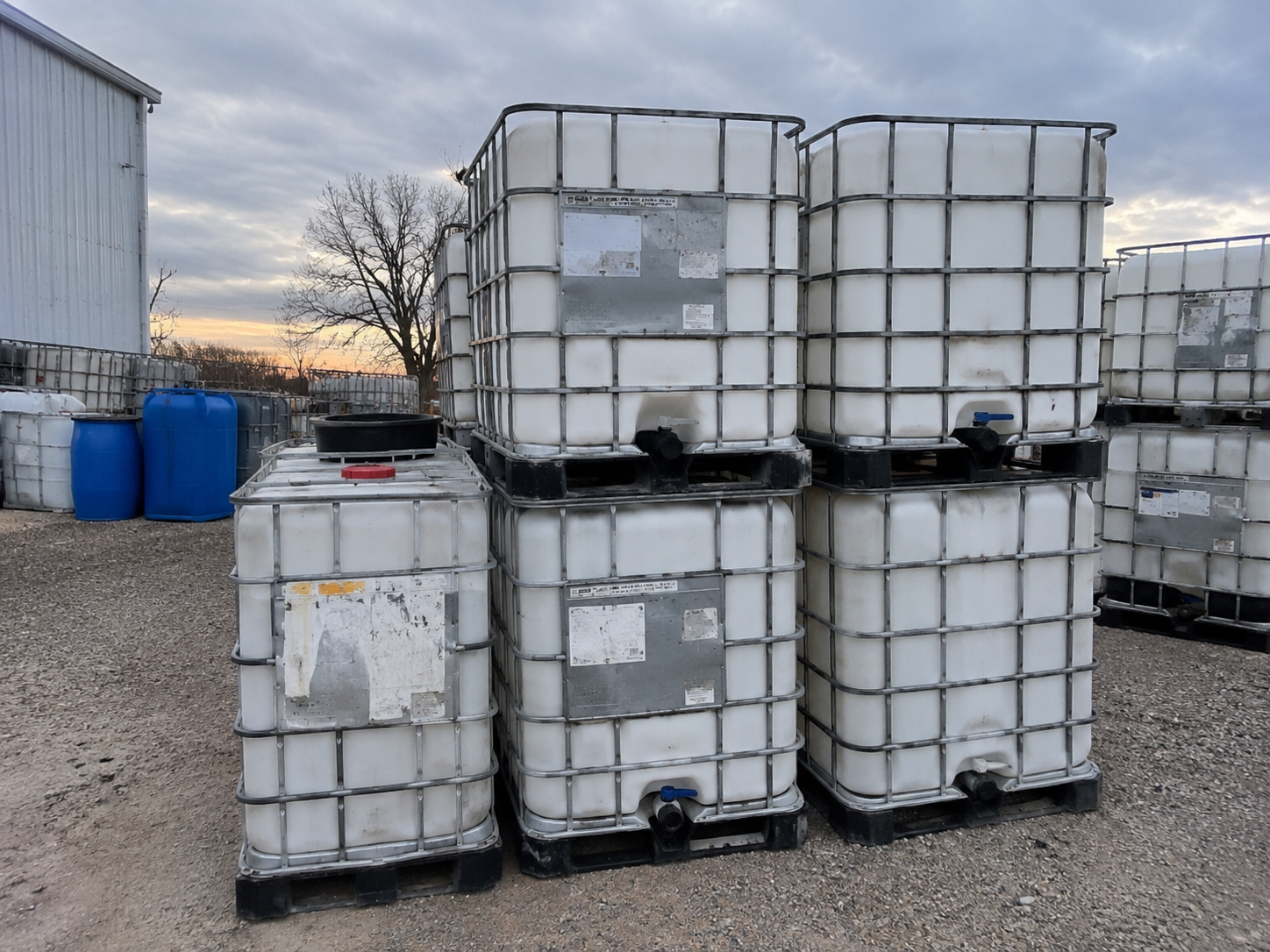
Sixteen years of taking the long way around a landfill.
Totes Nation was not a business plan. It was a pressure washer, a rented bay off Harry Hines, and a question nobody at the chemical plant could answer: what happens to all those empties?
Write to the founders
Press, partnership or a plant with 400 empties behind it - send it here.
How it actually happened.
One truck, one bay, one customer
Marisol Reyes and Dale Whitmore buy a 1998 box truck and start hauling empty totes away from a coatings plant in Garland for free. The plant was paying to dispose of them. The first 60 totes are washed by hand in a rented bay and resold to a car wash chain.
The first wash line
A used three-stage washer arrives from a dairy auction in Wisconsin. Capacity goes from 14 totes a day to 160. We hire four people and learn, expensively, that caustic concentration matters more than water temperature.
Governors Row
We move into the Dallas yard we still occupy. Eleven dock doors, a rail spur we have never used, and enough paved acreage to stage 9,000 units. Within a year it is full.
Rebottling starts
Customers want new-bottle cleanliness without new-tote pricing. We begin pressing fresh HDPE bottles into reclaimed, straightened cages. It becomes our single most popular product and remains so.
Food grade certification
After two years of protocol work, swab testing and an AIB audit, we start shipping food-grade reconditioned totes to juice, syrup and edible-oil processors.
Closing the loop
We install granulation on site. Bottles that fail inspection are shredded, washed and sold as clean HDPE regrind instead of going to a third-party broker. The zero-landfill policy becomes formal.
Freight desk
Customers kept asking us to arrange trucks. We stop pretending that is someone else's problem and build a freight desk that now books more than 2,600 loads a year.
Container management
The first managed fleet program launches with a specialty chemical blender: we own the containers, they use them, we collect, wash and return them on a schedule. Nobody buys anything new.
Upcycling shop
A corner of the yard becomes a fabrication shop. Totes too tired for liquid service leave as rain harvesting kits, aquaponics beds and wash stations instead of as flake.
1.94 million and counting
We cross 1.94 million containers kept in circulation since 2009. The milestone is announced on a whiteboard in the break room, which is exactly as much ceremony as it got.
The first year we lost money on every tote. We just could not stand watching them get crushed.
The economics were genuinely bad until 2012. Hand-washing a 275-gallon container takes nineteen minutes if you are fast, and the market price for a clean used tote in 2010 was not nineteen minutes of anyone’s time.
What changed was not the price. It was the volume and the discipline: a real wash line, a real grading standard, and the realization that the most valuable thing we sold was not the container but the certainty about what had been in it.
Sixteen years later that is still the product. The tote is just how it ships.
Meet the people running itEight decisions we got wrong first.
A founding story that only lists the good calls is marketing. These are the ones that cost real money before they taught us something.
| Year | What we believed | What it cost | What we do now |
|---|---|---|---|
| 2010 | Hand washing could scale with more people | Eighteen months of negative margin | A real wash line with measured chemistry |
| 2011 | Water temperature was the main cleaning variable | Gas, rewashes and a lot of arguments | Titrate caustic every shift and log it |
| 2012 | Grading could be a conversation | Returns, disputes, two lost customers | A written standard, audited quarterly |
| 2014 | Freight was somebody else's problem | Customers quoting LTL and walking away | An in-house freight desk and consolidation |
| 2015 | Old cages were scrap | Thousands of usable cages crushed | A hydraulic press and a rebottling line |
| 2017 | Food grade was a wash cycle | A failed first audit | Isolated circuit, documented history, swabs |
| 2019 | A third-party broker should take our failed bottles | No visibility on where material went | On-site granulation and a zero-landfill policy |
| 2021 | Texas does not need winterising advice | Several hundred cracked valves in four days | A November note to every customer in a freeze zone |
How the company actually makes money.
Unusually boring, deliberately. There is no clever financial engineering in a container yard.
Buying well
The margin is created at intake, not at sale. A lot bought accurately - with the reuse split estimated correctly - is profitable at market prices. A lot bought on optimism is not.
Washing cheaply
Counter-current water recovery, reclaimed caustic and a line that runs at capacity six days a week. Utility cost per container is the number we watch hardest.
Filling trailers
A half-empty truck destroys the economics of an otherwise good order. Consolidation is why a yard in Texas can compete in Ohio.
Not condemning things
Every percentage point of reuse rate is worth more than any price increase we could push through. Ninety-four percent is the current number.
Repeat relationships
A customer who sells us empties and buys containers back is two margins on one truck. Those relationships are the whole business model.
Saying no
Declining cargo we cannot handle, lots we cannot resell and claims we cannot support is how a reconditioner stays solvent and licensed.
How the used container business actually works.
Written down because almost nobody explains it, and understanding it makes every price on this site make sense.
A used IBC exists because somebody bought a liquid and the liquid came in a box. The box was a cost to them and becomes an asset to us. That single fact drives everything: supply is a by-product of somebody else’s business, which means it is lumpy, seasonal and completely indifferent to what our customers want this week.
When agricultural chemistry ships in spring, we are flooded with containers in June and short of them in February. When scrap steel prices rise, cages that should be rebottled get sold for scrap by people who do not look past the weight ticket, and donor stock dries up. When a large processor changes packaging format, a whole regional stream disappears overnight.
The job, then, is inventory judgement rather than selling. Buying the right lots at the right moment, grading honestly so stock does not come back, and keeping enough rebottle capacity to manufacture supply when the market will not provide it. Everything else - washing, testing, freight, fabrication - exists to serve that core.
Four close calls.
A sixteen year history told honestly has to include the parts that nearly did not work.
| Year | What happened | What it nearly cost | What changed afterwards |
|---|---|---|---|
| 2011 | A load of unlabelled drums reached the wash line | The discharge permit | Previous cargo logging became mandatory at intake |
| 2014 | A customer stacked damaged cages and one collapsed | Somebody could have been hurt | We began refusing to sell damaged cages at any price |
| 2017 | Regrind market collapsed, bales piled up | Half a year of cash | Zero landfill commitment plus the fabrication shop |
| 2020 | Demand vanished for ten weeks, then tripled | The whole trading year | Rebottle capacity doubled to smooth supply |
Sixteen years in, the ask is unchanged.
If you have empties, we want them. If you need containers, we have them washed and graded. Everything else is logistics.
The numbers people ask us for twice a week.
Specifications, capability and contact details in one block, so you never have to go hunting for them from wherever you happen to be on this site.
- Buy used IBC totes, drums, cages and pallets nationwide
- Sell reconditioned, rebottled and food grade containers
- Hot caustic wash with counter-current triple rinse
- Food grade protocol in an isolated circuit with swab verification
- UN 31HA1 leak and pressure testing with reconditioner marking
- Cage straightening, revalving and full hardware replacement
- Freight booking: partial, consolidated and full truckload
- Managed container fleet programmes from 150 units
- On-site granulation into clean HDPE regrind
- Custom fabrication, plumbing, branding and upcycled builds
Write to us
Every message is read by a person in Dallas and answered within one business day.
Container fast reference.
Nominal figures for the containers we stock. Gross weights assume water at 8.345 lb per gallon - multiply by your product specific gravity.
| Container | Capacity | Footprint | Height | Tare | Gross (water) | Outlet |
|---|---|---|---|---|---|---|
| Caged IBC, standard | 275 gal / 1,041 L | 48" x 40" | 46" | 125 lb | 2,419 lb | S60x6 |
| Caged IBC, tall | 330 gal / 1,249 L | 48" x 40" | 53" | 148 lb | 2,902 lb | S60x6 |
| Caged IBC, low profile | 180 gal / 681 L | 48" x 40" | 35" | 104 lb | 1,606 lb | S60x6 |
| Caged IBC, compact | 120 gal / 454 L | 40" x 32" | 34" | 78 lb | 1,079 lb | S60x6 |
| Stainless IBC | 350 gal / 1,325 L | 48" x 42" | 51" | 320 lb | 3,241 lb | NPT / TC |
| Poly drum, tight head | 55 gal / 208 L | 23" dia. | 35" | 22 lb | 481 lb | 2" NPS |
| Steel drum, tight head | 55 gal / 208 L | 23" dia. | 34" | 38 lb | 497 lb | 2" NPS |
Five answers that apply wherever you are.
01What does a used IBC tote actually cost?
It depends on grade, quantity and your distance from Dallas, and freight is often the biggest single variable. Grade C units are a fraction of Grade A, rebottled sits near the top, and food grade is priced by scarcity of documented stock. Send a quantity and a zip code and you get a landed number, not a range. The pricing guide shows the bands we work in on the buy-back side.
02How fast can I get containers?
Stock units leave the yard in two to three business days, rebottled in two to five, food grade in three to seven. Add transit: next day in the Texas triangle, two to three days through the Midwest and Southeast, three to five to the coasts. Full lane detail is on the locations page.
03Will you buy the empties I already have?
Yes, in all 48 contiguous states, including damaged units and mixed unsorted lots. Freight is netted into the price so you see one clear per-unit number, and within 150 miles of Dallas collection is free. Details on we buy your totes.
04How do I know what grade I need?
Tell us the cargo rather than the grade. We publish a written grading standard and we will usually recommend a cheaper grade than people ask for, because most jobs do not need appearance. The Tote Matchmaker encodes the same conversation in four questions.
05Why is there no phone number anywhere on this site?
Because we have never had one. Written answers give you a record, a quote you can forward and a grade you can hold us to, and they are a large part of why every request gets answered within one business day. The form on this page reaches the same people a phone line would have.
Everything, from here.
Containers
Services
Reference
Looking for something that is not listed? The full site index has every page, including the inner pages that are not in the main menu.