Graded honestly, priced accordingly.
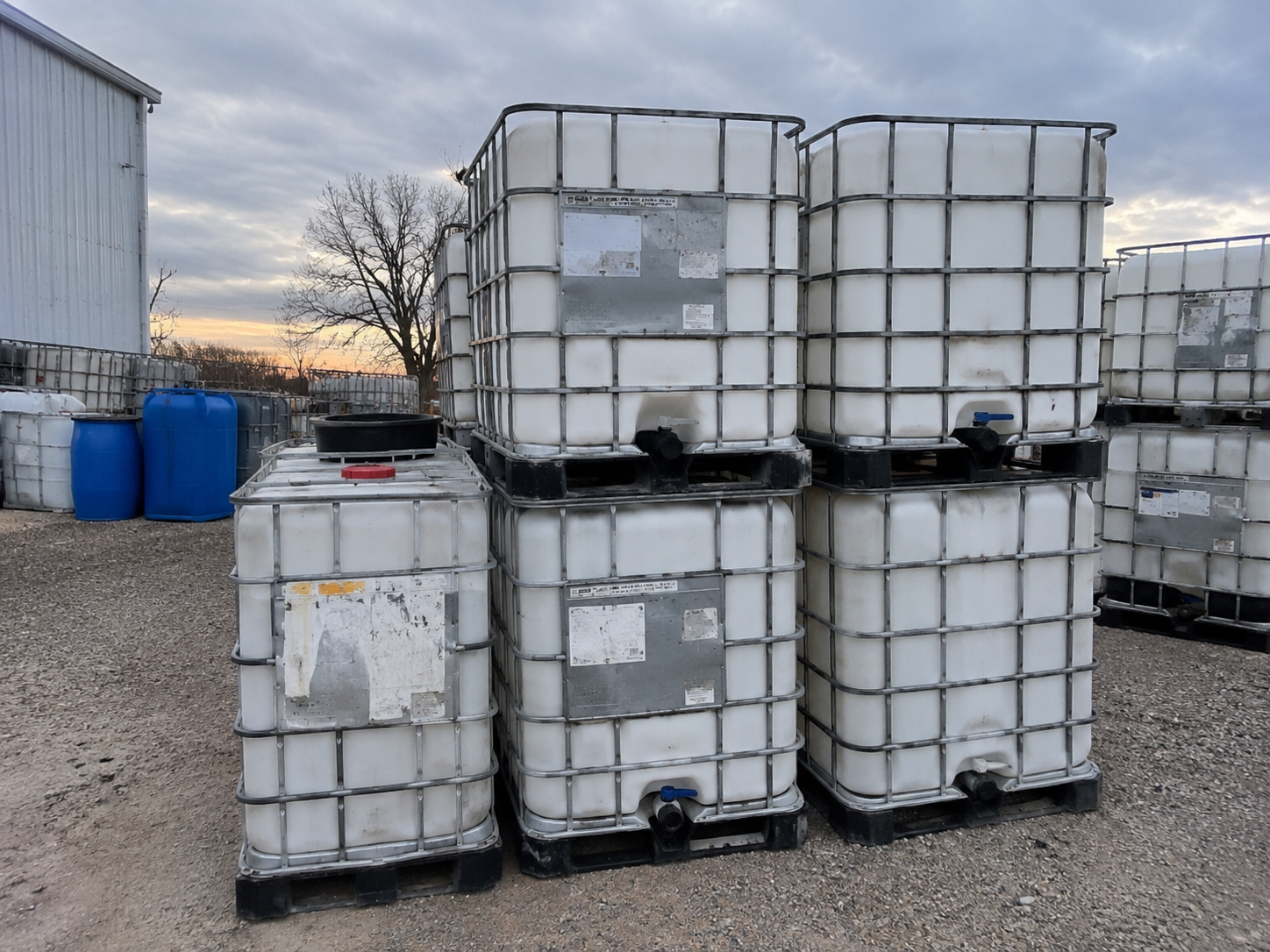
This is the container that keeps American industry wet: a 275 or 330 gallon HDPE bottle in a galvanized cage on a pallet. Ours are washed, leak tested, revalved where needed and graded by someone who gets no bonus for being generous.
Check grade availability
Grade A sells out first. Tell us how many and what for, and we will tell you which grade you actually need.
What the letter on the tag means.
We publish this because the industry's grades are famously inconsistent. Ours are written down and audited internally every quarter.
| Grade | Interior | Cage & pallet | Typical use | Indicative price band |
|---|---|---|---|---|
| A | Clear to light haze, no staining, no odor | Straight, bright galvanizing, clean pallet | Customer-facing product, resale packaging | $$$ |
| B | Light stain or haze, no residue, neutral odor | Minor dings, sound welds, serviceable pallet | Industrial process, water, dilute chemistry | $$ |
| C | Stained, sound, non-food, may hold odor | Cosmetic damage, structurally tested | Waste collection, outdoor use, site storage | $ |
| Rebottled | New virgin HDPE, never filled | Reclaimed, pressed straight | Anywhere a new interior is required | $$$ |
| Food grade | Washed in bay 4, swab verified | Inspected, new hardware | Food, beverage, edible ingredients | $$$$ |
What we do before one of these is allowed to be sold.
A used tote that has not been opened, washed, tested and logged is not a product, it is a liability with a pallet under it.
Standard caged IBC dimensions.
| Size | Capacity | L x W | Height | Tare | Gross |
|---|---|---|---|---|---|
| 275 standard | 275 gal / 1,041 L | 48" x 40" | 46" | 125 lb | 2,400 lb |
| 330 tall | 330 gal / 1,249 L | 48" x 40" | 53" | 148 lb | 2,890 lb |
| 180 low profile | 180 gal / 681 L | 48" x 40" | 35" | 104 lb | 1,610 lb |
| 120 compact | 120 gal / 454 L | 40" x 32" | 34" | 78 lb | 1,080 lb |
| 550 double | 550 gal / 2,082 L | 48" x 40" | 82" | 265 lb | 4,850 lb |
Things people wish they had asked.
01Can I stack these when full?
Most caged IBCs are rated for two high when full and four high empty, but it depends on cage design, pallet type and your product density. Ask us for the rating on the specific lot. Never stack a damaged cage.
02How old are the bottles?
Bottle manufacture date is stamped on the bottle and recorded at intake. We do not sell bottles older than five years into liquid service. Older cages, however, are often perfectly sound and get rebottled.
03Do you sell cage-only or bottle-only?
Yes, both - see accessories and parts. Cage-only units are popular with fabricators and farmers.
04What was in it before?
We will tell you. Every unit carries a logged previous cargo, and if that cargo is something you would rather not inherit, we will show you a different lot.
05Why is Grade C sometimes the smart buy?
Because rainwater, wash water, waste and site storage do not care about staining. Spending Grade A money on a yard tote is the most common mistake we talk people out of.
Who built it, and does it matter?
Four manufacturers dominate the North American caged IBC population. The differences are mostly in the cage geometry and the fittings.
| Maker | Typical cage | Outlet | Notes for buyers |
|---|---|---|---|
| Schutz | Tight mesh, formed bottom rail | S60x6 | Very common; cages press straight well |
| Mauser | Tubular, wider spacing | S60x6 | Robust pallets; good rebottle donors |
| Werit | Tubular with corner plates | S60x6 | Often found on European-origin cargo |
| Greif | Mixed designs | S60x6 | Hardware varies by generation |
| Imported / unbranded | Variable | S60x6 or S75x6 | Check thread before ordering adapters |
What actually ends a container's life.
From our own condemnation data. The order surprises people - chemistry is well down the list.
| Cause | Share of condemnations | Preventable? | How |
|---|---|---|---|
| UV crazing of the bottle | 41% | Largely | Store shaded or indoors |
| Cracked cage welds | 22% | Partly | Do not stack damaged cages; careful forklift work |
| Solvent attack and swelling | 14% | Yes | Fluorinated or stainless for the cargo |
| Breach - cut, drilled or patched | 9% | Yes | Do not modify containers you intend to reuse |
| Freeze damage | 6% | Yes | Drain below the valve, leave headspace |
| Odour retention | 5% | Partly | Rinse at emptying, avoid fragrance in reusable fleets |
| Illegible UN plate | 3% | Yes | Do not paint over the plate |
What was in it, and what that costs you.
Every intake is logged against the previous cargo. This is the table our graders work from when they decide whether a unit is washable, rebottlable or scrap.
| Previous cargo class | Typical outcome | Wash protocol | Resale route |
|---|---|---|---|
| Food, beverage, edible oils | Highest value stream | Bay 4 isolated circuit, swab verified | Food grade or Grade A |
| Water, glycol, de-icer | Clean and easy | Standard hot caustic, triple rinse | Grade A or B |
| Detergents and surfactants | Foams badly, washes clean | Extended rinse, anti-foam dosing | Grade A or B |
| Agricultural chemistry | Depends on active | Triple rinse plus neutralisation | Grade B, never food |
| Latex, resin, adhesive | Often cured solid | Mechanical strip, usually rebottle | Rebottled or cage salvage |
| Solvents and aromatics | Bottle usually swollen | Not washed - condemned | Cage salvage, bottle to regrind |
| Fragrance and essential oils | Odour absorbed into wall | Extended wash, 14-day air cure | Grade B industrial only |
| Acids and caustics | Fittings attacked first | Neutralise, full hardware swap | Grade B with new gasket set |
| Unknown or unlabelled | Declined at intake | None | Returned or quoted as scrap |
What a caged IBC actually costs per fill.
Purchase price is the number people compare. Cost per fill is the number that decides whether you bought well.
| Scenario | Up-front | Expected fills | Cost per fill | Where it goes at end of life |
|---|---|---|---|---|
| Grade C, outdoor water storage | Lowest | 20 to 40 | Pennies | Regrind, cage salvaged |
| Grade B, industrial process | Low | 15 to 30 | Low | Rebottle donor |
| Grade A, customer-facing | Medium | 10 to 25 | Medium | Downgrade to B, then C |
| Rebottled, dedicated service | High | 30 to 60 | Lowest over life | Rebottle again |
| Food grade, documented | Highest | 8 to 20 | Highest | Industrial downgrade |
| New single-trip | Very high | 1 to 5 | Very high | Usually landfilled elsewhere |
Twelve minutes that prevent most complaints.
Do this on the dock while the driver is still there. Almost every dispute we have ever had would have been settled in the first quarter hour.
Count on the trailer
Count units before the forklift moves, and write the number on the bill of lading before signing it.
Walk the cages
Look for bent bottom rails, cracked welds and crush marks on the top frame. Photograph anything odd immediately.
Open and smell
Lid off, one honest breath. Odour is the single most common reason a unit gets sent back, and it shows up instantly.
Check the outlet
Confirm thread, valve type and that a cap and gasket are fitted. Cycle the handle once, closed to open to closed.
Tell us the job, not the grade.
Describe the cargo and the environment and we will recommend the cheapest grade that will actually work. It is usually not the one people ask for.
The numbers people ask us for twice a week.
Specifications, capability and contact details in one block, so you never have to go hunting for them from wherever you happen to be on this site.
- Buy used IBC totes, drums, cages and pallets nationwide
- Sell reconditioned, rebottled and food grade containers
- Hot caustic wash with counter-current triple rinse
- Food grade protocol in an isolated circuit with swab verification
- UN 31HA1 leak and pressure testing with reconditioner marking
- Cage straightening, revalving and full hardware replacement
- Freight booking: partial, consolidated and full truckload
- Managed container fleet programmes from 150 units
- On-site granulation into clean HDPE regrind
- Custom fabrication, plumbing, branding and upcycled builds
Write to us
Every message is read by a person in Dallas and answered within one business day.
Container fast reference.
Nominal figures for the containers we stock. Gross weights assume water at 8.345 lb per gallon - multiply by your product specific gravity.
| Container | Capacity | Footprint | Height | Tare | Gross (water) | Outlet |
|---|---|---|---|---|---|---|
| Caged IBC, standard | 275 gal / 1,041 L | 48" x 40" | 46" | 125 lb | 2,419 lb | S60x6 |
| Caged IBC, tall | 330 gal / 1,249 L | 48" x 40" | 53" | 148 lb | 2,902 lb | S60x6 |
| Caged IBC, low profile | 180 gal / 681 L | 48" x 40" | 35" | 104 lb | 1,606 lb | S60x6 |
| Caged IBC, compact | 120 gal / 454 L | 40" x 32" | 34" | 78 lb | 1,079 lb | S60x6 |
| Stainless IBC | 350 gal / 1,325 L | 48" x 42" | 51" | 320 lb | 3,241 lb | NPT / TC |
| Poly drum, tight head | 55 gal / 208 L | 23" dia. | 35" | 22 lb | 481 lb | 2" NPS |
| Steel drum, tight head | 55 gal / 208 L | 23" dia. | 34" | 38 lb | 497 lb | 2" NPS |
Five answers that apply wherever you are.
01What does a used IBC tote actually cost?
It depends on grade, quantity and your distance from Dallas, and freight is often the biggest single variable. Grade C units are a fraction of Grade A, rebottled sits near the top, and food grade is priced by scarcity of documented stock. Send a quantity and a zip code and you get a landed number, not a range. The pricing guide shows the bands we work in on the buy-back side.
02How fast can I get containers?
Stock units leave the yard in two to three business days, rebottled in two to five, food grade in three to seven. Add transit: next day in the Texas triangle, two to three days through the Midwest and Southeast, three to five to the coasts. Full lane detail is on the locations page.
03Will you buy the empties I already have?
Yes, in all 48 contiguous states, including damaged units and mixed unsorted lots. Freight is netted into the price so you see one clear per-unit number, and within 150 miles of Dallas collection is free. Details on we buy your totes.
04How do I know what grade I need?
Tell us the cargo rather than the grade. We publish a written grading standard and we will usually recommend a cheaper grade than people ask for, because most jobs do not need appearance. The Tote Matchmaker encodes the same conversation in four questions.
05Why is there no phone number anywhere on this site?
Because we have never had one. Written answers give you a record, a quote you can forward and a grade you can hold us to, and they are a large part of why every request gets answered within one business day. The form on this page reaches the same people a phone line would have.
Everything, from here.
Containers
Services
Reference
Looking for something that is not listed? The full site index has every page, including the inner pages that are not in the main menu.