Freight booked by people who have loaded the trailer.
Container freight is strange: light, bulky, stackable only sometimes, and brutal on margin if booked wrong. We run our own trucks close to home and broker the rest through carriers who know what an IBC load looks like.
Get a freight number
Origin, destination, unit count and whether there is a dock or a forklift. That is all we need.
How many fit, honestly.
These are the numbers we load to. Anyone quoting you more is stacking something that should not be stacked.
| Equipment | Empty caged IBCs | Full caged IBCs | Poly drums | Notes |
|---|---|---|---|---|
| 53 ft dry van | 80 (double stacked) | 40 (single) | 80 palletized | Dock to dock, most common |
| 48 ft flatbed | 40 single / 72 stacked | 36 | 72 | Needs tarps if weather matters |
| Step deck | 44 single | 40 | 76 | Lower deck height for tall units |
| 26 ft box truck | 18 | 12 | 24 | Our own fleet, inside 300 miles |
| Partial (LTL consolidated) | 4-20 | 4-16 | 8-40 | Consolidated with our outbound |
Typical lane times from Dallas.
Standard dry van, no expedite. Add a day for residential, limited-access or appointment-only deliveries.
Texas triangle
Houston, Austin, San Antonio
Near Midwest & South
OKC, Little Rock, Shreveport, Memphis
Southeast & Plains
Atlanta, Nashville, Denver, Kansas City
Coasts
Los Angeles, Phoenix, Chicago, Northeast
Make the delivery go well.
01Do I need a dock?
A dock or a forklift. Totes are too heavy and awkward for a liftgate in any quantity. If you have neither, tell us before we book - we can arrange a truck with a moffett.
02What about residential delivery?
Possible for small quantities with the right equipment, but it costs more and needs clear access. Rain harvesting kits going to homes are the usual case and we plan for it.
03How are units secured?
Stretch wrapped by column, strapped to the deck, with dunnage between stacked rows. Flatbeds are tarped on request.
04Can you ship to my customer directly?
Yes, with blind or double-blind bills of lading and your branding on the paperwork. Distributors do this with us constantly.
05What if something arrives damaged?
Note it on the delivery receipt, photograph it, and email us the same day. We file the claim and replace the unit - you should not be chasing a carrier.
The charges that surprise people.
Published because a surprise accessorial after delivery is the fastest way to lose a customer, and because most of them are avoidable with one sentence up front.
| Charge | When it applies | How to avoid it |
|---|---|---|
| Liftgate | No dock and no forklift at delivery | Tell us in advance; a moffett truck is usually cheaper than a liftgate for totes |
| Limited access | Farms, residences, schools, construction sites | Declare it when quoting - it is not a penalty, it is a different truck |
| Appointment / detention | Receiver cannot unload within the free window | Confirm receiving hours and have someone ready |
| Redelivery | Nobody available at the scheduled time | Confirm the window the day before |
| Reconsignment | Address changed in transit | Check the ship-to before dispatch |
| Storage | Shipment held at a terminal | Usually follows a failed delivery attempt |
| Tarping | Flatbed loads needing weather protection | Specify at quote; sometimes a van is cheaper |
| Inside delivery | Beyond the dock or tailgate | Rare for totes; plan equipment instead |
How a trailer of containers is actually built.
Load building is a craft. Done badly it damages containers, wastes space and occasionally fails a DOT inspection.
Empties stack, fulls mostly do not
Empty caged IBCs double stack routinely, which is why 80 fit on a van. Full units stack only within the cage rating, product density and carrier policy.
Pinwheel for the last positions
Rotating units in the nose and tail recovers two to four positions on a 53 ft trailer without compromising securement.
Dunnage between stacked rows
Prevents cage-to-bottle contact in transit, which is a real and under-appreciated source of damage.
Stretch wrap by column, strap to the deck
Wrap holds a column together; straps hold it to the trailer. Both are needed and neither substitutes for the other.
Valves inboard, capped
A valve handle facing the wall cannot be knocked by a fork or a shifting pallet.
Heaviest over the axles
Weight distribution matters on mixed loads with drums and totes together.
What arrives at your dock, and what it needs.
Trailer type decides whether your site can take the delivery at all. Check this before ordering rather than when the driver is outside.
| Equipment | Deck height | Totes per load | Needs a dock? | Best for |
|---|---|---|---|---|
| 53 ft dry van | 50" | 48 single, 80 double | Yes, or a forklift with long tines | Standard full loads |
| 48 ft dry van | 50" | 44 single | Yes | Older docks, tight yards |
| 53 ft flatbed | 60" | 40 strapped | No - side unload | Sites with no dock |
| Step deck | 42" lower deck | 44 | No | Tall loads, 330 gal stacked |
| Curtainside | 50" | 44 | No - side access | Awkward sites, part loads |
| 26 ft box truck with liftgate | 48" | 12 to 14 | No | Small deliveries, no forklift |
| Hotshot trailer | 34" | 8 to 10 | No | Urgent small lots |
| Our own flatbed, Texas only | 58" | 40 | No | Local collection and delivery |
The paperwork that travels with a load.
Knowing what should be in the driver's hand means you can spot a missing document before you sign for the load rather than three weeks later.
| Document | Issued by | Travels with | You need it for |
|---|---|---|---|
| Bill of lading | Shipper | Every load | Proof of count and condition |
| Packing list | Us | Every load | Reconciling what arrived |
| Grade certificate | Us | Graded container orders | Knowing what you bought |
| Certificate of cleanliness | Us | Food grade orders | Your audit file |
| Previous cargo declaration | Us | Food grade and on request | Your audit file |
| Test and recertification record | Us | Recertified units | DOT compliance |
| Weight ticket | Scale house | Buy-back collections | Settlement |
| Delivery photographs | Driver or yard | On request | Damage disputes |
Damage, shortage and what to do in the first hour.
Freight claims are won or lost on the dock, not in the email thread afterwards. Four rules, all of them boring, all of them decisive.
01Note it on the bill of lading before you sign
A clean signed bill of lading is close to an admission that the load arrived intact. If anything is short, crushed, wet or leaking, write it on the bill before the driver leaves, and be specific - the number of units and the nature of the damage. A note saying “subject to inspection” is weaker than a count.
02Photograph before unloading
Photographs of the load still on the trailer are the strongest evidence there is, because they show the state of the load before your own equipment touched it. Take wide shots and close shots, and make sure the trailer number is visible in at least one.
03Do not refuse the whole load over a few units
Refusing a load sends everything back and starts a second freight charge. Accept what is sound, note the damaged units on the paperwork, and tell us the count. We will replace or credit the damaged units, which is faster and cheaper for both of us.
04Tell us within 48 hours
Carrier claim windows are short and most carriers will refuse concealed damage claims after a few days. Send the photographs and the annotated bill of lading within two business days and we will handle the carrier. After that window the claim is much harder and sometimes impossible.
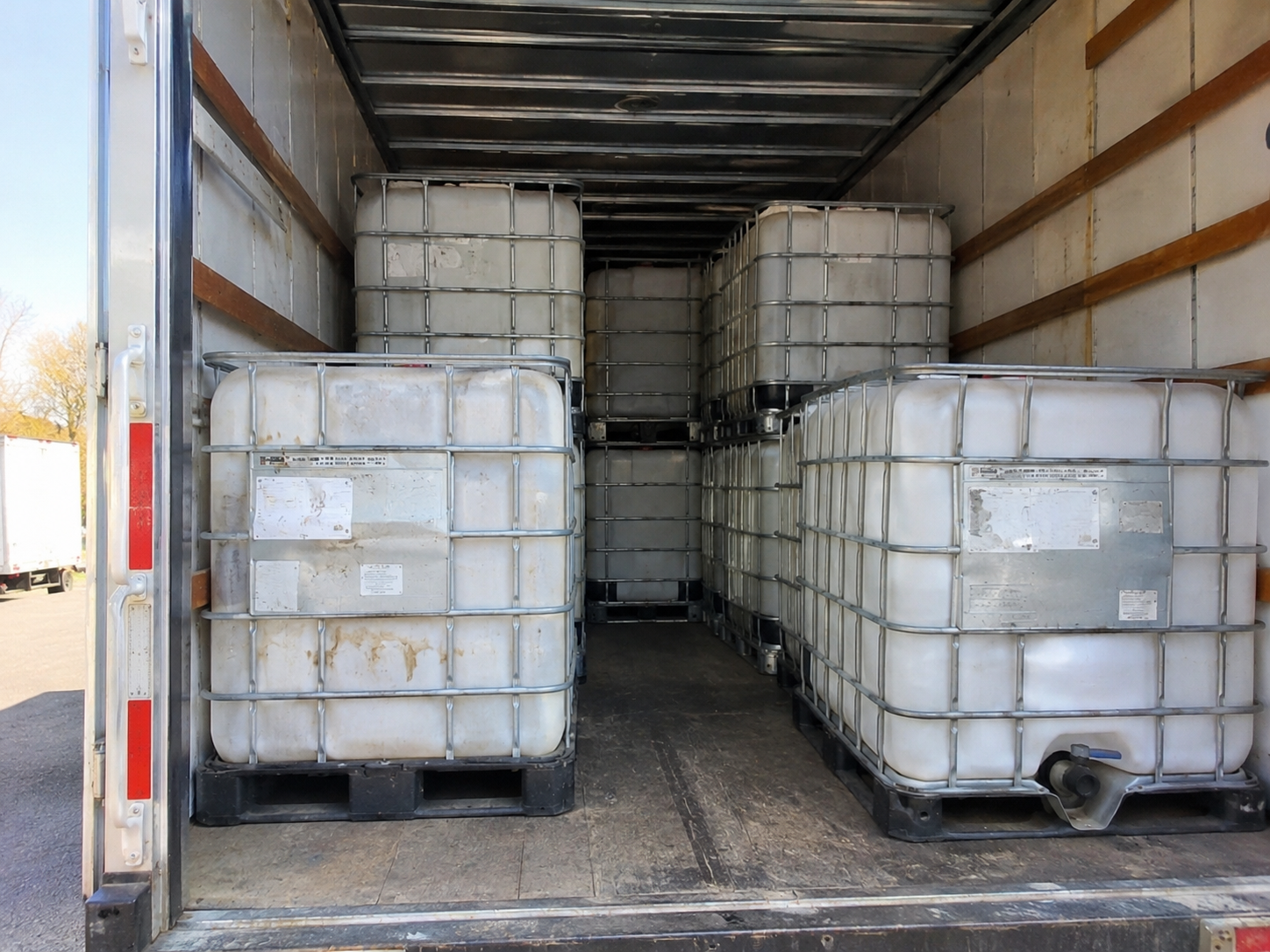
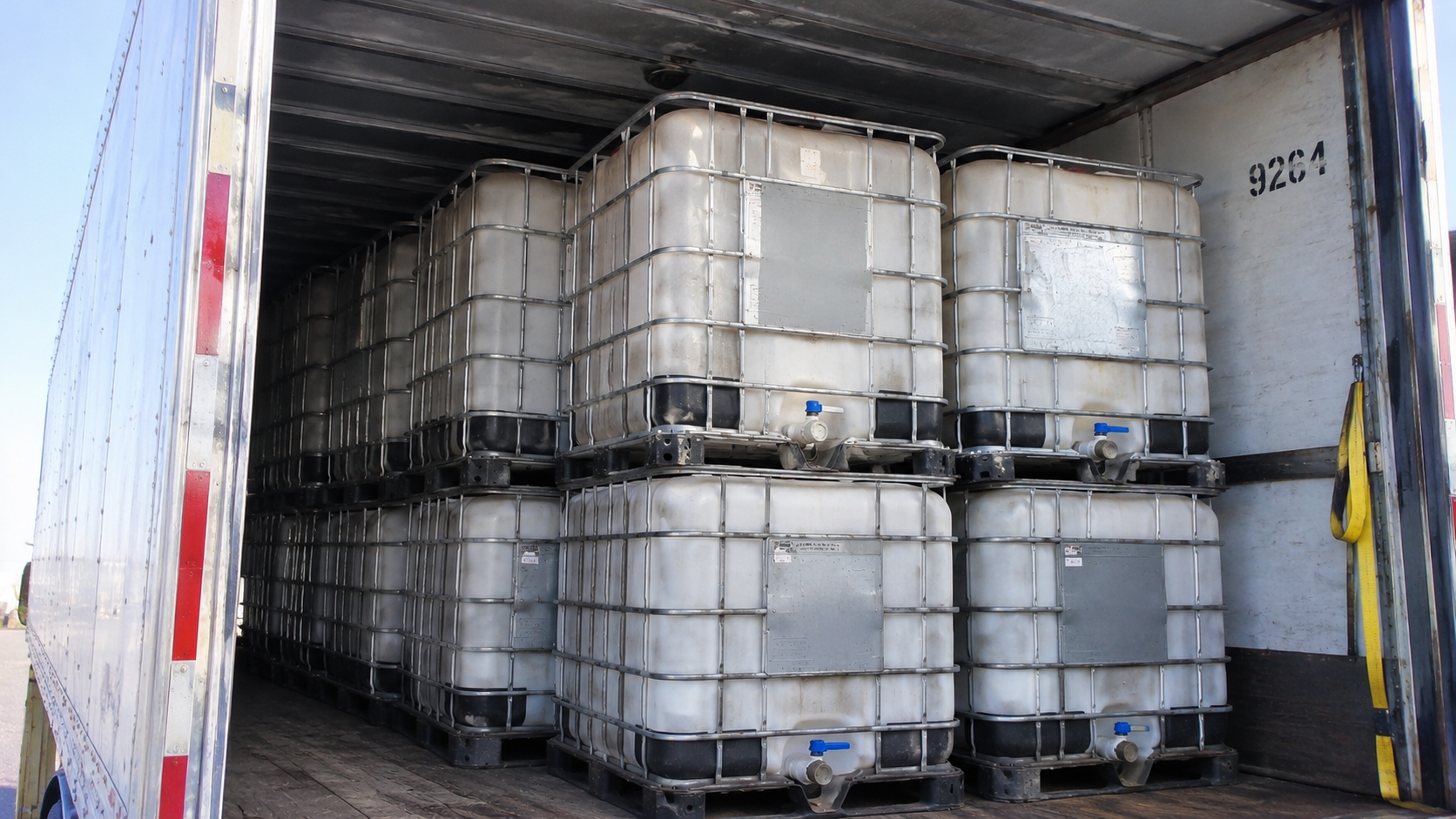
What 14 units and 80 units actually look like.
The difference between a box truck and a double-stacked 53 footer is most of the difference in your freight cost per container.
One request, one landed price.
We quote product and freight together, because a cheap tote with an expensive truck is not a deal.
The numbers people ask us for twice a week.
Specifications, capability and contact details in one block, so you never have to go hunting for them from wherever you happen to be on this site.
- Buy used IBC totes, drums, cages and pallets nationwide
- Sell reconditioned, rebottled and food grade containers
- Hot caustic wash with counter-current triple rinse
- Food grade protocol in an isolated circuit with swab verification
- UN 31HA1 leak and pressure testing with reconditioner marking
- Cage straightening, revalving and full hardware replacement
- Freight booking: partial, consolidated and full truckload
- Managed container fleet programmes from 150 units
- On-site granulation into clean HDPE regrind
- Custom fabrication, plumbing, branding and upcycled builds
Write to us
Every message is read by a person in Dallas and answered within one business day.
Container fast reference.
Nominal figures for the containers we stock. Gross weights assume water at 8.345 lb per gallon - multiply by your product specific gravity.
| Container | Capacity | Footprint | Height | Tare | Gross (water) | Outlet |
|---|---|---|---|---|---|---|
| Caged IBC, standard | 275 gal / 1,041 L | 48" x 40" | 46" | 125 lb | 2,419 lb | S60x6 |
| Caged IBC, tall | 330 gal / 1,249 L | 48" x 40" | 53" | 148 lb | 2,902 lb | S60x6 |
| Caged IBC, low profile | 180 gal / 681 L | 48" x 40" | 35" | 104 lb | 1,606 lb | S60x6 |
| Caged IBC, compact | 120 gal / 454 L | 40" x 32" | 34" | 78 lb | 1,079 lb | S60x6 |
| Stainless IBC | 350 gal / 1,325 L | 48" x 42" | 51" | 320 lb | 3,241 lb | NPT / TC |
| Poly drum, tight head | 55 gal / 208 L | 23" dia. | 35" | 22 lb | 481 lb | 2" NPS |
| Steel drum, tight head | 55 gal / 208 L | 23" dia. | 34" | 38 lb | 497 lb | 2" NPS |
Five answers that apply wherever you are.
01What does a used IBC tote actually cost?
It depends on grade, quantity and your distance from Dallas, and freight is often the biggest single variable. Grade C units are a fraction of Grade A, rebottled sits near the top, and food grade is priced by scarcity of documented stock. Send a quantity and a zip code and you get a landed number, not a range. The pricing guide shows the bands we work in on the buy-back side.
02How fast can I get containers?
Stock units leave the yard in two to three business days, rebottled in two to five, food grade in three to seven. Add transit: next day in the Texas triangle, two to three days through the Midwest and Southeast, three to five to the coasts. Full lane detail is on the locations page.
03Will you buy the empties I already have?
Yes, in all 48 contiguous states, including damaged units and mixed unsorted lots. Freight is netted into the price so you see one clear per-unit number, and within 150 miles of Dallas collection is free. Details on we buy your totes.
04How do I know what grade I need?
Tell us the cargo rather than the grade. We publish a written grading standard and we will usually recommend a cheaper grade than people ask for, because most jobs do not need appearance. The Tote Matchmaker encodes the same conversation in four questions.
05Why is there no phone number anywhere on this site?
Because we have never had one. Written answers give you a record, a quote you can forward and a grade you can hold us to, and they are a large part of why every request gets answered within one business day. The form on this page reaches the same people a phone line would have.
Everything, from here.
Containers
Services
Reference
Looking for something that is not listed? The full site index has every page, including the inner pages that are not in the main menu.