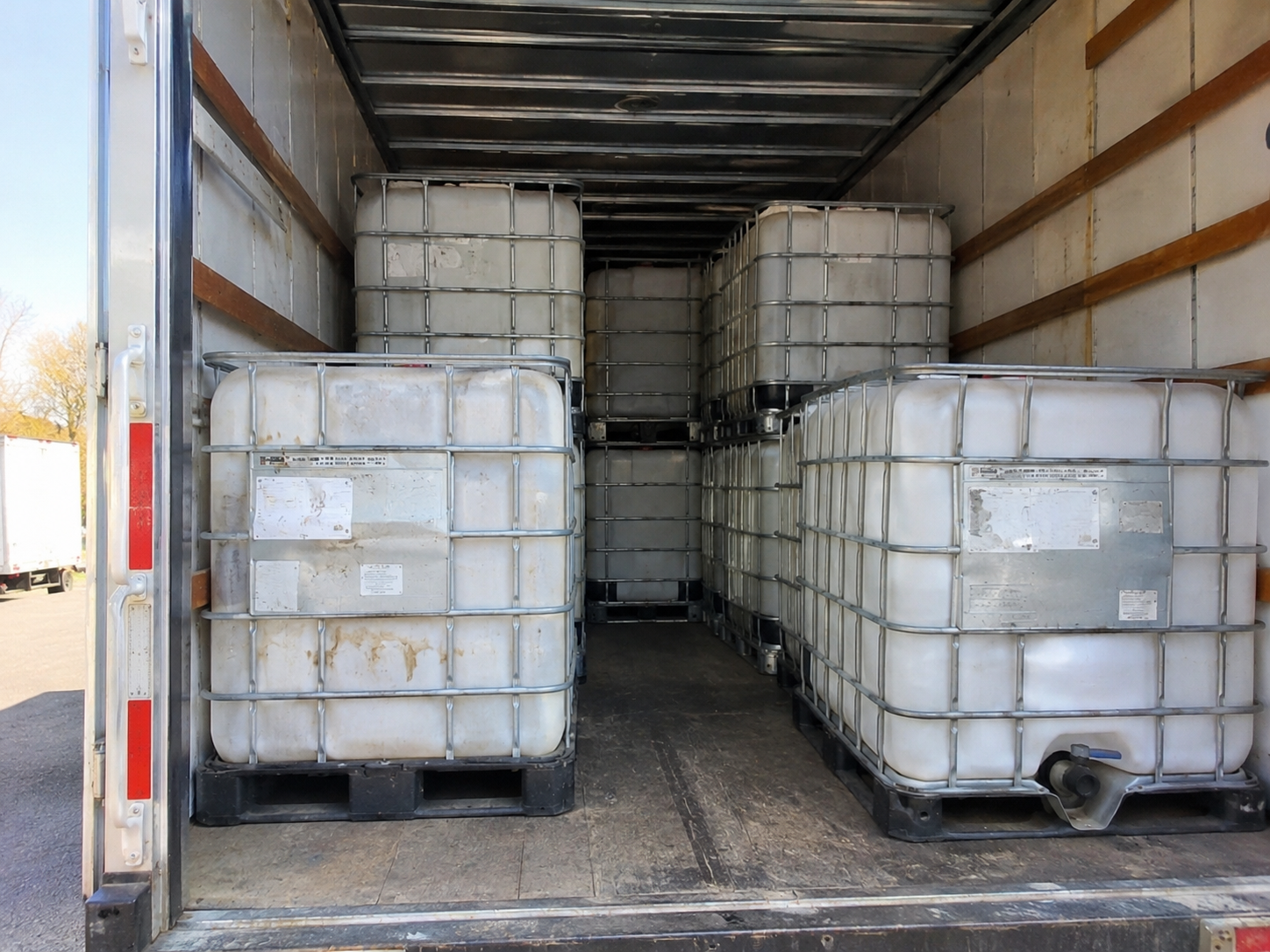
The most expensive tote you can buy is a cheap one on LTL.
Totes are light and enormous. LTL carriers price by density class, and an empty IBC is about the least dense freight in commerce. Here is the actual math, and when LTL is still the right answer.
Compare freight options
Give us the count and destination and we will quote partial, consolidated and full truckload side by side.
Why an empty tote prices like a sofa.
An empty 275 gallon caged IBC weighs about 125 lb and occupies roughly 43 cubic feet on the floor. That is about 5 lb per cubic foot, which lands in the worst freight classes the LTL system has. You pay for the space, not the weight, and then you pay again for handling because the unit cannot be stacked under anything.
Four totes on LTL to the Midwest routinely cost more than twenty totes on a consolidated partial leaving our yard on a Thursday. This is the single most common place we save customers money, and it costs us nothing but scheduling.
How consolidation works here
We run outbound freight constantly. If your four units can wait three or four days, they ride with somebody else’s twenty-six on a truck already going that direction. You pay a share of a truckload rate instead of a full LTL tariff.
When LTL is genuinely right
- One or two units needed urgently with no flexibility on timing.
- Parts, valves and gaskets - small parcel or LTL is perfect for these.
- Destinations off our lanes where waiting for consolidation means two weeks.
The same 16 totes, three ways.
Illustrative Dallas to Atlanta figures from this year. Your lane will differ; the shape of the answer will not.
| Method | Transit | Relative cost | Flexibility | Verdict |
|---|---|---|---|---|
| Standard LTL | 4-6 days | Highest | Ship any day | Avoid unless urgent |
| Consolidated partial | 3-5 days | ~45% of LTL | Ships on our lane days | Usually the winner |
| Dedicated truckload | 2-3 days | ~70% of LTL | Ships when you want | Best if you can fill it |
Questions about partials.
01How long do I wait for a consolidation?
Usually two to five days on our regular lanes - Texas, the Southeast, the Midwest corridor and the Southwest. We will tell you the next departure before you commit.
02Can I mix products on a partial?
Yes. Totes, drums, parts and an upcycled kit on one bill of lading is completely normal.
03Does a partial cost more per unit than a truckload?
Slightly, yes. But it beats LTL dramatically, and it means you are not buying 40 units to make the freight work.
04What about backhauls?
If we are collecting empties near your delivery, the truck often does both. Those are our cheapest moves and we pass that on.
Nobody has ever regretted waiting three days to save sixty percent on the truck.
Why empty totes price so badly on LTL.
LTL carriers price on density. An empty IBC is one of the least dense objects in general commerce, and the tariff reflects it.
| Item | Weight | Cube | Density | Freight behaviour |
|---|---|---|---|---|
| Empty caged IBC, 275 gal | 125 lb | ~43 cu ft | ~2.9 lb/cu ft | Worst case - you pay for air |
| Empty caged IBC, 330 gal | 148 lb | ~49 cu ft | ~3.0 lb/cu ft | Same problem, slightly larger |
| Full caged IBC, water | 2,419 lb | ~43 cu ft | ~56 lb/cu ft | Dense, but rarely shipped LTL |
| Pallet of 4 poly drums | ~100 lb | ~24 cu ft | ~4.2 lb/cu ft | Poor, but better than totes |
| Carton of valves and gaskets | 25 lb | ~1.5 cu ft | ~17 lb/cu ft | Fine - parcel or LTL both work |
Pick the method in four questions.
This is the logic our freight desk applies before quoting anything.
How many units?
Under four, consider pickup or LTL. Four to twenty, consolidate. Forty-plus, dedicated truckload.
How fast?
If it has to move today, LTL is honest and expensive. If it can wait three days, consolidation usually halves the cost.
Where to?
On one of our regular lanes, consolidation departs within days. Off-lane destinations wait longer and may favour LTL.
Anything coming back?
If you also have empties to clear, say so. A backhaul is the cheapest truck in the business and both legs get cheaper.
What mode suits what count.
Round numbers, Dallas origin, typical lanes. The pattern holds almost everywhere: there is an awkward band in the middle where neither mode is comfortable.
| Units | Usual mode | Why | Transit penalty | Watch out for |
|---|---|---|---|---|
| 1 to 3 | Parcel or hotshot | Too small for a pallet rate | None | Parcel will not take an IBC at all |
| 4 to 8 | LTL | Fits a few pallet positions | 1 to 2 days | Freight class is brutal on empties |
| 9 to 16 | LTL or volume LTL | Volume rates start to appear | 2 to 3 days | Reweighs and reclassification |
| 17 to 30 | Volume LTL or partial | The awkward band | 2 to 4 days | Often cheaper to buy more units |
| 31 to 44 | Partial truckload | Dedicated space, no handling | 0 to 1 day | Pricing moves with available capacity |
| 45 to 48 | Full truckload | Cheapest per unit by a distance | None | You must be able to unload it |
| 49 to 80 | Full truckload, double stacked | Only if empties and cargo allow | None | Needs a dock and height clearance |
| Over 80 | Multiple loads | Scheduled over days | Varies | Storage on your side |
Why buying more often costs less.
This surprises people every week, so here is a worked version. The freight curve is not linear and the step at full truckload is enormous.
| Order | Mode | Freight shape | Freight per unit | All-in per unit |
|---|---|---|---|---|
| 8 units | LTL, 4 pallet positions | Class-rated, handled 3 times | Very high | High |
| 16 units | Volume LTL | Class-rated, handled twice | High | Mid to high |
| 24 units | Partial truckload | Linehaul share | Moderate | Mid |
| 48 units | Full truckload | One linehaul, no handling | Lowest | Lowest |
Let us quote all three.
You will see LTL, consolidated and truckload next to each other and pick with full information.
The numbers people ask us for twice a week.
Specifications, capability and contact details in one block, so you never have to go hunting for them from wherever you happen to be on this site.
- Buy used IBC totes, drums, cages and pallets nationwide
- Sell reconditioned, rebottled and food grade containers
- Hot caustic wash with counter-current triple rinse
- Food grade protocol in an isolated circuit with swab verification
- UN 31HA1 leak and pressure testing with reconditioner marking
- Cage straightening, revalving and full hardware replacement
- Freight booking: partial, consolidated and full truckload
- Managed container fleet programmes from 150 units
- On-site granulation into clean HDPE regrind
- Custom fabrication, plumbing, branding and upcycled builds
Write to us
Every message is read by a person in Dallas and answered within one business day.
Container fast reference.
Nominal figures for the containers we stock. Gross weights assume water at 8.345 lb per gallon - multiply by your product specific gravity.
| Container | Capacity | Footprint | Height | Tare | Gross (water) | Outlet |
|---|---|---|---|---|---|---|
| Caged IBC, standard | 275 gal / 1,041 L | 48" x 40" | 46" | 125 lb | 2,419 lb | S60x6 |
| Caged IBC, tall | 330 gal / 1,249 L | 48" x 40" | 53" | 148 lb | 2,902 lb | S60x6 |
| Caged IBC, low profile | 180 gal / 681 L | 48" x 40" | 35" | 104 lb | 1,606 lb | S60x6 |
| Caged IBC, compact | 120 gal / 454 L | 40" x 32" | 34" | 78 lb | 1,079 lb | S60x6 |
| Stainless IBC | 350 gal / 1,325 L | 48" x 42" | 51" | 320 lb | 3,241 lb | NPT / TC |
| Poly drum, tight head | 55 gal / 208 L | 23" dia. | 35" | 22 lb | 481 lb | 2" NPS |
| Steel drum, tight head | 55 gal / 208 L | 23" dia. | 34" | 38 lb | 497 lb | 2" NPS |
Five answers that apply wherever you are.
01What does a used IBC tote actually cost?
It depends on grade, quantity and your distance from Dallas, and freight is often the biggest single variable. Grade C units are a fraction of Grade A, rebottled sits near the top, and food grade is priced by scarcity of documented stock. Send a quantity and a zip code and you get a landed number, not a range. The pricing guide shows the bands we work in on the buy-back side.
02How fast can I get containers?
Stock units leave the yard in two to three business days, rebottled in two to five, food grade in three to seven. Add transit: next day in the Texas triangle, two to three days through the Midwest and Southeast, three to five to the coasts. Full lane detail is on the locations page.
03Will you buy the empties I already have?
Yes, in all 48 contiguous states, including damaged units and mixed unsorted lots. Freight is netted into the price so you see one clear per-unit number, and within 150 miles of Dallas collection is free. Details on we buy your totes.
04How do I know what grade I need?
Tell us the cargo rather than the grade. We publish a written grading standard and we will usually recommend a cheaper grade than people ask for, because most jobs do not need appearance. The Tote Matchmaker encodes the same conversation in four questions.
05Why is there no phone number anywhere on this site?
Because we have never had one. Written answers give you a record, a quote you can forward and a grade you can hold us to, and they are a large part of why every request gets answered within one business day. The form on this page reaches the same people a phone line would have.
Everything, from here.
Containers
Services
Reference
Looking for something that is not listed? The full site index has every page, including the inner pages that are not in the main menu.