New bottle. Old cage. That is the whole trick.
A rebottled IBC gives you a factory-fresh HDPE interior inside a steel cage and pallet that have already been made once. You get new-container cleanliness without paying - financially or environmentally - for 73 pounds of new steel.
Price rebottled units
Quantities over 40 ship as a full truckload. Tell us your zip and we will land the delivered number.
A container that is half new on purpose.
The bottle is the part that touches your product, carries your contamination risk and wears out first. The cage and pallet are structural steel that lasts decades. Rebottling replaces only the part that needs replacing.
Every rebottled unit leaves here with a new bottle blown from FDA-compliant virgin HDPE, a fresh gasket set, a new discharge valve and cap, and a cage that has been straightened on a hydraulic press and inspected weld by weld. The pallet is steel or composite depending on what you need under a forklift.
Good fit for
- Specialty chemicals sold onward to customers who judge the container.
- Products where interior cleanliness is non-negotiable but history is irrelevant.
- Buyers who want a new-tote look without a new-tote purchase order.
- Sustainability programs that need steel reuse they can actually document.
Not the right call when
- Your cargo is water or waste - a Grade B used tote does that job for much less.
- You need verified food-contact chain of custody; go to food grade instead.
- The chemistry attacks HDPE - look at stainless or fluorinated composite.
How a rebottle is built.
Cage reclaimed
Donor unit stripped, cage pressed straight, welds inspected, rust treated.
Bottle blown
New virgin HDPE bottle sourced to FDA 21 CFR 177.1520 with lot documentation.
Married
Bottle seated, hardware fitted, torque logged, gaskets new throughout.
Tested & marked
Leak and pressure test, UN remark where required, graded and tagged.
Rebottled range.
| Model | Capacity | Footprint | Height | Pallet | Valve |
|---|---|---|---|---|---|
| RB-275-S | 275 gal / 1,041 L | 40" x 48" | 46" | Steel | 2" butterfly |
| RB-275-C | 275 gal / 1,041 L | 40" x 48" | 46" | Composite | 2" butterfly |
| RB-330-S | 330 gal / 1,249 L | 40" x 48" | 53" | Steel | 2" butterfly |
| RB-275-BV | 275 gal / 1,041 L | 40" x 48" | 46" | Steel | 2" ball valve |
| RB-180-LP | 180 gal / 681 L | 40" x 48" | 35" | Steel | 2" butterfly |
Rebottled questions.
01Is a rebottled tote as good as a brand-new one?
For the interior, it is identical - same resin specification, never filled. The difference is a cage with a work history, which is cosmetic unless it failed inspection, in which case it would not be here.
02Does it count as recycled content?
No, and we will not let you say that it does. The bottle is virgin resin. The environmental saving is reuse of 73 lb of steel and full diversion of the donor unit - which is a bigger number anyway.
03Can it carry regulated goods?
Yes, when ordered with a 31HA1/Y marking and test documentation. Say so on the order; we mark and test accordingly. See UN / DOT codes.
04What happens to the bottle you removed?
It is granulated on site into clean HDPE regrind and sold to extruders. Nothing from a donor unit goes to landfill.
Rebottled against the alternatives.
The comparison people actually need before signing a purchase order.
| New IBC | Rebottled | Grade A used | Food grade used | |
|---|---|---|---|---|
| Interior condition | Never filled | Never filled | Light haze possible | Washed, swab verified |
| Cage and pallet | New steel | Reclaimed, pressed | Used, inspected | Used, inspected |
| Cargo history | None | None | Logged | Verified food-only |
| Relative cost | Highest | ~60% of new | ~45% of new | Varies with scarcity |
| Lead time | Weeks | 2-5 days | 2-3 days | 3-7 days |
| Steel avoided | 0 lb | 73 lb | 73 lb | 73 lb |
| Suitable for food | Yes | Yes, as food grade build | No | Yes |
| UN markable | Yes | Yes, on request | If plate legible | If plate legible |
What you can specify on a rebottled order.
None of these add meaningful lead time if specified with the order. All of them add a day or two if asked for afterwards.
| Option | Choices | Why you would |
|---|---|---|
| Pallet | Steel, composite, plastic | Composite for export and food; steel for lowest height |
| Valve | 2" butterfly, 2" ball, 3" butterfly | Ball for positive shutoff; 3 in. for viscous product |
| Seat material | EPDM, FKM (Viton) | FKM for solvents, fuels and oils |
| Lid | Vented or solid, tamper seal | Vented prevents vacuum collapse on fast discharge |
| Adapter fitted | Camlock, NPT, tri-clamp, garden hose | Arrives ready to connect, no labour charge |
| UN marking | 31HA1/Y with test record | Required for regulated goods |
| Branding | Stencil, silk screen, full wrap | Branded containers come back more reliably |
| Opaque conversion | UV wrap or paint | Algae and light control for water service |
What goes into a new HDPE bottle.
A rebottle is only as good as the bottle, so here is the specification of the ones we fit, written out the way a resin buyer would want it.
| Property | Typical value | Test method | Why it matters to you |
|---|---|---|---|
| Resin | High molecular weight HDPE, virgin | - | No recycled content means no unknown history |
| Density | 0.950 to 0.956 g/cm3 | ASTM D792 | Sets stiffness and chemical resistance |
| Melt flow index | 0.3 to 0.7 g/10 min | ASTM D1238 | Low MFI gives better stress crack resistance |
| ESCR | Greater than 500 hours | ASTM D1693 | Resistance to cracking under surfactant load |
| Wall thickness, sidewall | 1.8 to 2.4 mm | Ultrasonic gauge | Thin spots are where UV failure starts |
| Wall thickness, corners | 2.4 to 3.2 mm | Ultrasonic gauge | Corners carry the stacking load |
| UV package | Carbon black or HALS stabiliser | - | Natural bottles must be stored shaded |
| Service temperature | -40 F to 140 F | - | Above 140 F the bottle softens and bulges |
| Food contact | FDA 21 CFR 177.1520 compliant | Supplier declaration | Required for any edible cargo |
How we decide a cage is worth rebottling.
The cage is the part we reuse, so it gets the harder inspection. A cage that fails any of these is cut up for scrap rather than dressed with a new bottle.
| Check | Accept | Reject | Fix available |
|---|---|---|---|
| Weld integrity | All joints sound | Any cracked or separated weld on a load path | Re-weld if a single non-structural joint |
| Frame geometry | Within 10 mm of square | Twisted frame, racked corners | Press straight in the jig |
| Galvanizing | Surface rust only | Flaking, perforated or heavily scaled | Wire wheel and zinc-rich coat |
| Bottom rail | Straight, no crush | Crushed by forklift tines | Replace rail section |
| Pallet, steel | Flat, no tears | Torn deck, bent runners | Panel replacement |
| Pallet, composite | No delamination | Split or waterlogged | Swap to steel |
| Pallet, wood | Sound stringers | Split stringers, loose deck boards | Swap to steel or composite |
| Outlet collar | Concentric, undamaged | Deformed or cracked | Replace collar assembly |
Getting sixty fills out of a rebottle.
A rebottled unit has the longest service life of anything we sell, but only if it is treated like an asset rather than packaging.
The failure curve for a new HDPE bottle is almost entirely driven by two things: ultraviolet exposure and thermal cycling. Chemistry is a distant third for the cargo classes most of our customers run. Store a rebottle indoors or under cover and you roughly double the number of fills you will get out of it before the sidewall starts to craze.
The second big lever is dedication. A unit that carries one product for its whole life needs only a rinse between fills, stays clean, and never picks up the odour or residue that forces a downgrade. Mixed service is what turns a four-year asset into a one-year one.
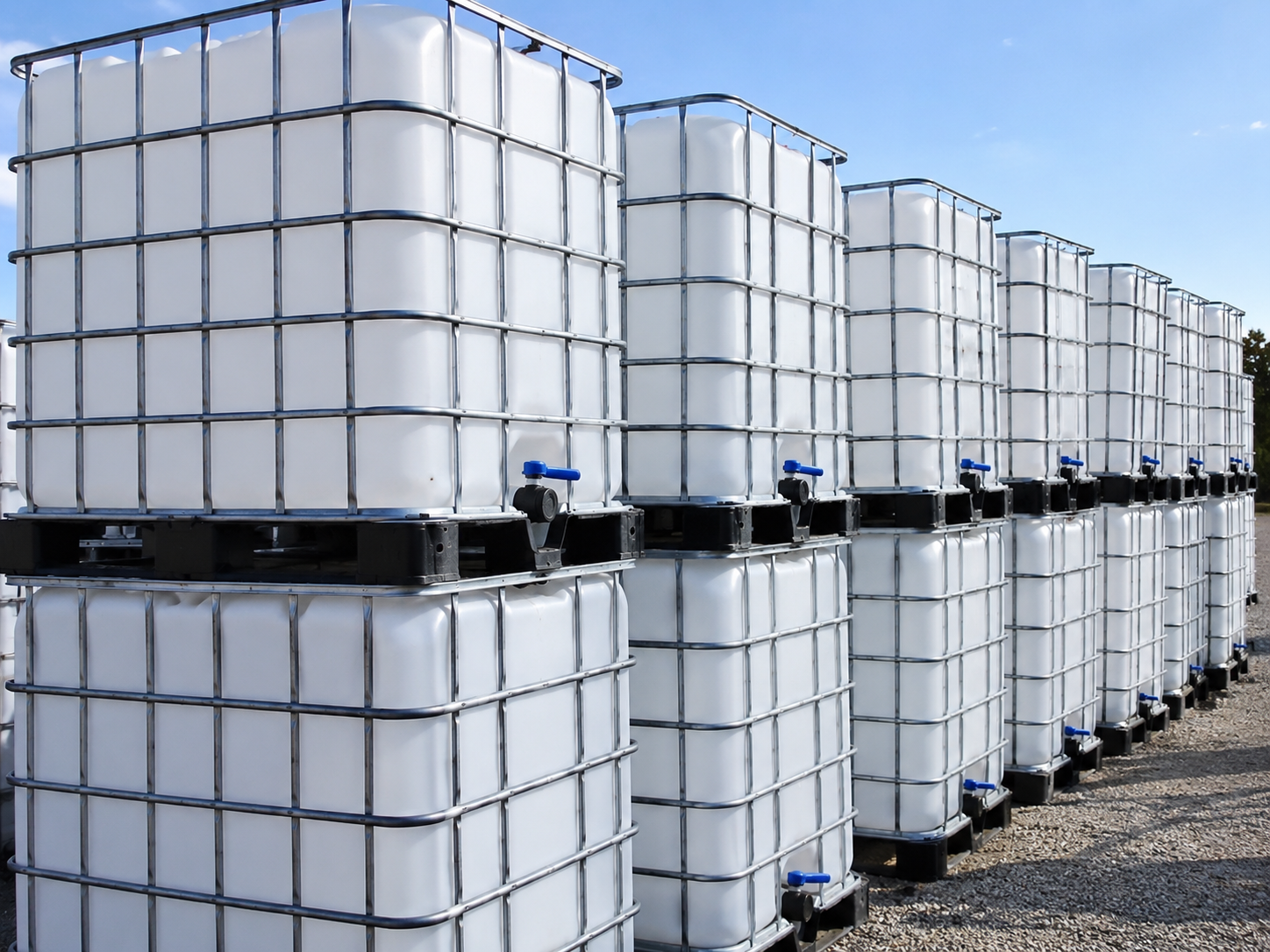
A new bottle in a cage that has already had one life.
The cage and the pallet are the heavy, carbon-expensive parts, and they are the parts worth keeping. Put a new virgin HDPE bottle inside a straightened, inspected cage and you get a container with a new interior at well under the price of a new unit.
Rebottled, delivered, this week.
We usually have rebottled stock on the floor. Give us a quantity and a zip code and you will have a landed price tomorrow.
The numbers people ask us for twice a week.
Specifications, capability and contact details in one block, so you never have to go hunting for them from wherever you happen to be on this site.
- Buy used IBC totes, drums, cages and pallets nationwide
- Sell reconditioned, rebottled and food grade containers
- Hot caustic wash with counter-current triple rinse
- Food grade protocol in an isolated circuit with swab verification
- UN 31HA1 leak and pressure testing with reconditioner marking
- Cage straightening, revalving and full hardware replacement
- Freight booking: partial, consolidated and full truckload
- Managed container fleet programmes from 150 units
- On-site granulation into clean HDPE regrind
- Custom fabrication, plumbing, branding and upcycled builds
Write to us
Every message is read by a person in Dallas and answered within one business day.
Container fast reference.
Nominal figures for the containers we stock. Gross weights assume water at 8.345 lb per gallon - multiply by your product specific gravity.
| Container | Capacity | Footprint | Height | Tare | Gross (water) | Outlet |
|---|---|---|---|---|---|---|
| Caged IBC, standard | 275 gal / 1,041 L | 48" x 40" | 46" | 125 lb | 2,419 lb | S60x6 |
| Caged IBC, tall | 330 gal / 1,249 L | 48" x 40" | 53" | 148 lb | 2,902 lb | S60x6 |
| Caged IBC, low profile | 180 gal / 681 L | 48" x 40" | 35" | 104 lb | 1,606 lb | S60x6 |
| Caged IBC, compact | 120 gal / 454 L | 40" x 32" | 34" | 78 lb | 1,079 lb | S60x6 |
| Stainless IBC | 350 gal / 1,325 L | 48" x 42" | 51" | 320 lb | 3,241 lb | NPT / TC |
| Poly drum, tight head | 55 gal / 208 L | 23" dia. | 35" | 22 lb | 481 lb | 2" NPS |
| Steel drum, tight head | 55 gal / 208 L | 23" dia. | 34" | 38 lb | 497 lb | 2" NPS |
Five answers that apply wherever you are.
01What does a used IBC tote actually cost?
It depends on grade, quantity and your distance from Dallas, and freight is often the biggest single variable. Grade C units are a fraction of Grade A, rebottled sits near the top, and food grade is priced by scarcity of documented stock. Send a quantity and a zip code and you get a landed number, not a range. The pricing guide shows the bands we work in on the buy-back side.
02How fast can I get containers?
Stock units leave the yard in two to three business days, rebottled in two to five, food grade in three to seven. Add transit: next day in the Texas triangle, two to three days through the Midwest and Southeast, three to five to the coasts. Full lane detail is on the locations page.
03Will you buy the empties I already have?
Yes, in all 48 contiguous states, including damaged units and mixed unsorted lots. Freight is netted into the price so you see one clear per-unit number, and within 150 miles of Dallas collection is free. Details on we buy your totes.
04How do I know what grade I need?
Tell us the cargo rather than the grade. We publish a written grading standard and we will usually recommend a cheaper grade than people ask for, because most jobs do not need appearance. The Tote Matchmaker encodes the same conversation in four questions.
05Why is there no phone number anywhere on this site?
Because we have never had one. Written answers give you a record, a quote you can forward and a grade you can hold us to, and they are a large part of why every request gets answered within one business day. The form on this page reaches the same people a phone line would have.
Everything, from here.
Containers
Services
Reference
Looking for something that is not listed? The full site index has every page, including the inner pages that are not in the main menu.